
By day she watches the Bloomberg Terminal. By night she turns Chanel jackets, quantum physics and Elliott waves into canvases now on view in San Francisco.
Most artists keep a sketchbook within reach. Grace Zhang keeps a Bloomberg Terminal. The San Francisco painter works in finance, and the screen sits right next to her canvas, which means she spends her days flipping between cryptocurrency charts and wet paint. “I’m constantly moving between the two worlds,” she says.
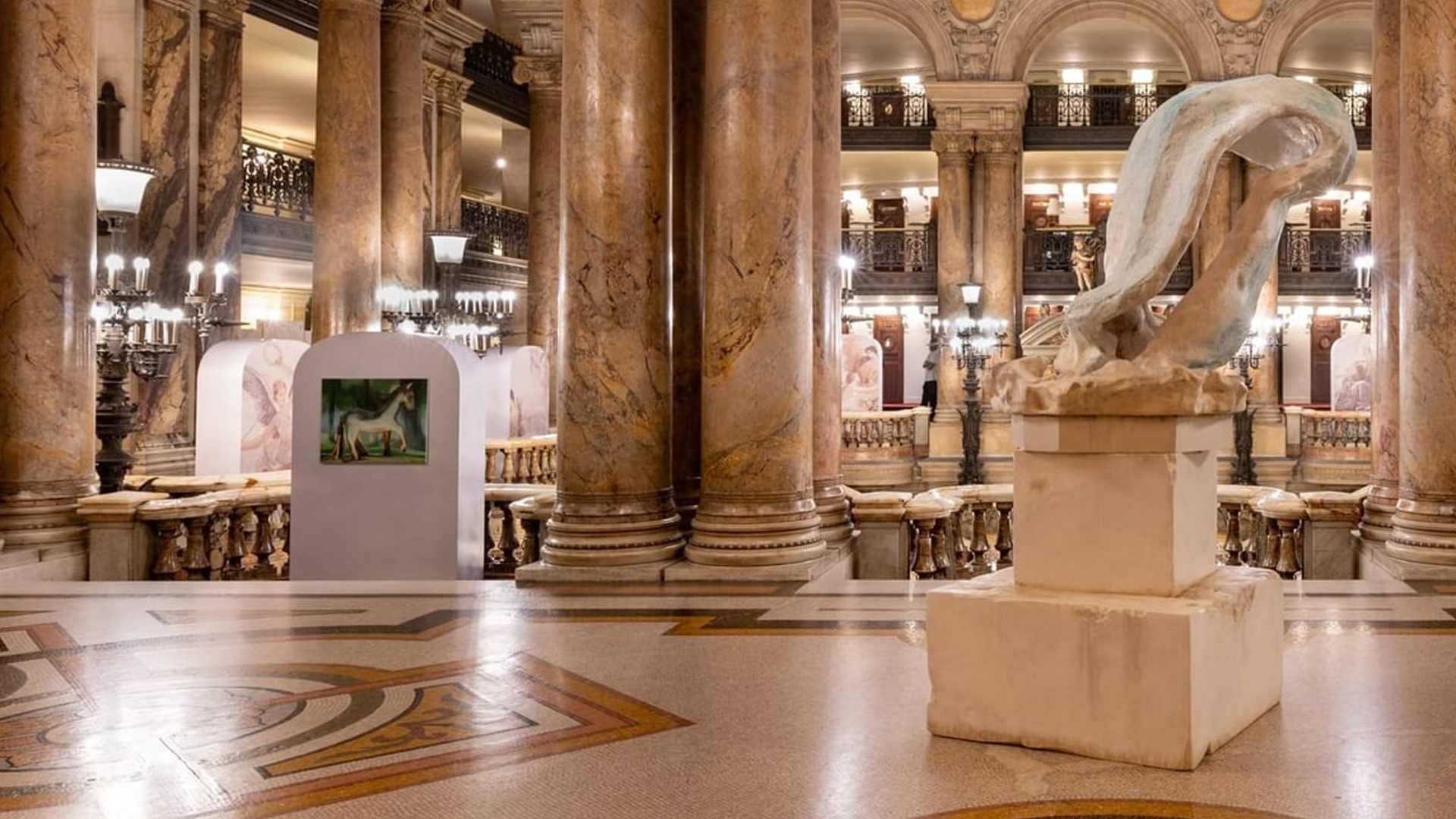
Her first public exhibition of paintings, Spacetime Monologue, is at the GCS Agency gallery in San Francisco and closes Oct. 25. It gathers 32 works across three strands: self-portraits inspired by haute couture, paintings that interpret science and financial markets, and a golf series. That sounds like three different artists. Zhang insists it’s one.

Chaos, with a pattern in it
A Columbia graduate of the international affairs program, Zhang describes painting as a way to “decompress from the intensity of the markets.” But she doesn’t treat it as an escape from her day job so much as a second angle on it. “They may seem completely different,” she says, “but both are about looking for patterns, understanding cycles, and making sense of what can initially feel like chaos.”
Her shorthand for the practice is “Buddhist philosophy meets the structural logic I find in Cézanne.” The Cézanne part carries over to the jewelry and fine watches she also designs, where his structural approach to color and form is the reference point. The paintings run on saturated, contrasting color, geometric shapes, and a recurring pair of motifs: dots and waves. Those two marks tie together works that start in very different places, whether science, travel or the markets.
Her touchstone outside the visual arts is Bach. The piece that has left the deepest mark on her is his “Fugue No. 24 in B minor,” and her reason reads like an artist’s statement: she loves the balance between structure and emotion, how something so carefully built can carry such profound feeling. She wants the same from her canvases, which aim for “complexity and order, but also tenderness, passion, and a quiet sense of transcendence.”
A mountain that looks like a chart
The clearest example of her method is Jade Hash. On a trip to Lijiang, Zhang noticed the jagged outline of Jade Dragon Mountain against the sky and saw something familiar. “Its ridgeline reminded me of the market charts I watch every day, from cryptocurrency to U.S. debt,” she says. In the painting, the silhouette becomes a simplified line of peaks and troughs, a wave that links landscape to finance.

Behind that sits Elliott wave theory, a school of technical analysis holding that markets move in recurring wave patterns shaped by collective investor psychology: fear and greed, despair and euphoria. Zhang says the notion that something as chaotic as a market might have an underlying rhythm is what sparked her. On canvas, she explains, those cycles “become waves, rising and falling across the canvas, and they carry the same emotional swings.”
Physics supplies another wave. Quantum Whisper draws on the double-slit experiment, in which light produces a wave-like interference pattern until you measure which slit each photon passes through, at which point the pattern vanishes and light acts like particles. “I was drawn to the idea that something as fundamental as light can be both at once, and that the act of looking changes what we see,” she says. Dots and waves become the painting’s visual language for that duality.
The Chanel self-portraits
The self-portraits are where couture enters, with nods to both Chanel and Dior. Each starts with a specific garment.
Self Portrait I began with her first Chanel haute couture jacket, from the Spring-Summer 2021 collection (Look 5). She was taken by its wave-like pattern and read it through the wave nature of light. In the painting, the jacket’s blue and yellow tones sit against a red, universe-like background, and its reflective details turn into stars.

Self-Portrait—One Night at Dar El Bacha features a look from Chanel’s Spring-Summer 2024 haute couture collection (Look 45). Zhang links it to her travels in Morocco and to the geometric traditions of Islamic art. The dark ensemble and its colorful embellishments, she says, evoke the night sky and “humanity’s fascination with the cosmos.”
So a jacket becomes a galaxy, and a runway look becomes a sky. It’s an unusual way to use fashion in painting: not as status or surface, but as a prompt for cosmology.
Golf, as a portal
Her newest series, Aurora Undae Country Club, pairs her fascination with the cosmos with her love of golf. She imagines the sport as “a portal between earthly experience and cosmic space.” It’s the least expected pairing on the wall, and it fits. A fairway is a managed landscape with rules, and Zhang’s interest keeps landing where order meets something larger and less tidy.
She frames the whole project as a search for “the underlying structures and principles of the universe, a sense that beneath everything around us lies a deeper truth.” Alongside that she wants room for “the constant flow of impressions, stories, and encounters,” including travel, fashion and financial markets. The finance career, the couture and the Buddhist questions about life and death don’t compete in her work. They feed each other, and a wave line can come from a mountain, a market or a jacket.
Via Design Milk