
By Hannah
What to Look for Before Choosing a Custom Suit Maker in NYC
New York City has hundreds of custom suit makers, and a quick search makes nearly all of them sound equally qualified. They all claim precision. They all promise a perfect fit. But a custom suit is a serious investment – often starting above $1,000 – and the difference between a suit you wear for decades and one that ends up in the back of your closet comes down to a handful of factors most buyers don’t think to ask about. Knowing what to look for before you choose a custom suit maker in NYC protects both your money and your time. The process itself, the people who handle your measurements, the fabrics available, and the proven track record behind the name all matter far more than the storefront’s appearance or the salesperson’s pitch. Walk into any consultation knowing these criteria, and you’ll spot a serious suit maker immediately, and spot a shortcut operation just as fast.
The Tailoring Process Is the First Thing to Evaluate
Not every shop calling itself a custom suit maker follows the same process, and those differences produce very different results. The makers behind the best custom suits in NYC build their approach around a basted fitting, a stage where the suit gets temporarily assembled early on so the suit maker can assess the fit on your actual body before final construction begins. This step costs time and labor, which is exactly why some shops skip it. When you ask a potential suit maker about their process, listen for specific stages: consultation, measurement, basted fitting, and final construction. “We do several fittings” tells you nothing. A precise answer explaining what each stage achieves signals that the suit maker understands why each step exists. The best makers don’t cut corners on process; their reputation depends on getting that sequence right every single time.
Why a Basted Fitting Changes the Final Result
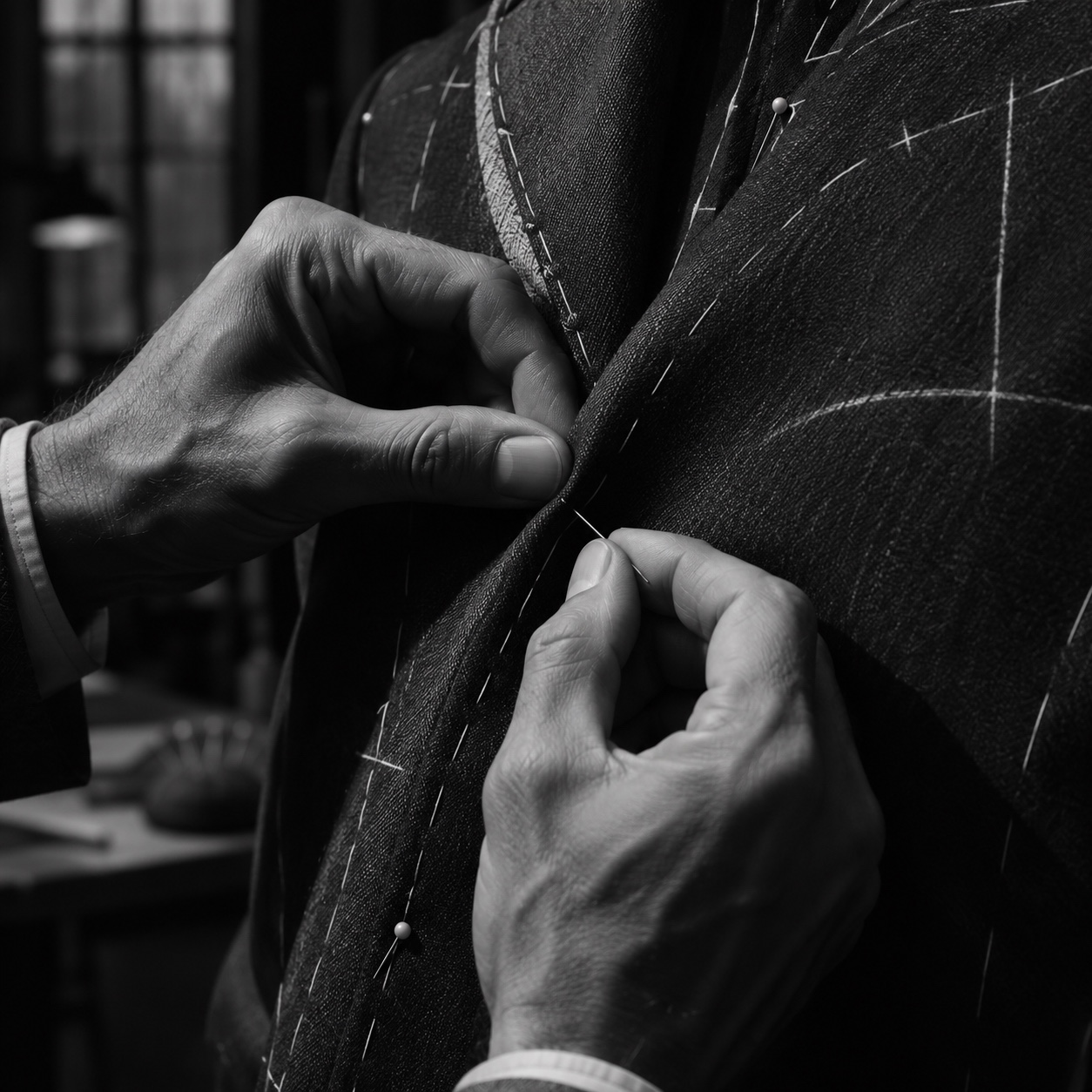
A basted fitting is where the garment gets assembled with temporary stitching so you can wear it, move in it, and let the suit maker observe exactly how it sits on your body. Without this stage, the suit maker is working from measurements alone, and no set of numbers fully captures how a person actually stands and moves. Minor asymmetries – one shoulder slightly lower, a forward head posture, a prominent seat – only become visible when you put the garment on. A suit maker who includes a basted fitting can catch and correct these details before anything gets permanently constructed. One who skips it delivers a finished garment and then tries to alter their way to a better fit, which is a far less accurate approach. Ask any potential custom suit maker in NYC directly: “Do you do a basted or skeleton fitting?” If the answer’s no, or they look uncertain about what you mean, that’s a clear signal to keep looking.
Who Takes Your Measurements Matters as Much as the Process
This detail surprises many first-time buyers, but it’s one of the most telling signs of a serious tailoring operation. In many shops, measurements get taken by a sales associate, not a master tailor or pattern cutter. A sales associate can use a tape measure competently, but they don’t have the trained eye to assess posture, spot asymmetry, or decide how measurements translate into a pattern that fits your specific body. Master tailors spend years developing that judgment. When your measurements get taken by someone who also has pattern-cutting experience, the numbers they record carry real diagnostic value. So before you commit to any suit maker, ask plainly: “Who takes measurements, and what’s their background?” A good shop will tell you a master tailor handles this step. A shop that’s vague about it – or confirms it’s the sales staff – is one where fit gets treated as less important than convenience.
Fabric Selection Reveals How Serious a Suit Maker Is
The fabrics a suit maker stocks tell you a great deal about their standards and their relationships with the best mills in the world. Any suit maker worth considering should source from recognized English and Italian mills; names like Loro Piana, Zegna, or Dormeuil appear regularly among serious operators. These fabrics come in a wide range of weights, weaves, and compositions, each suited to different climates, occasions, and levels of formality. A suit maker who can speak knowledgeably about Super 120s versus Super 150s wool, about the difference between a fresco weave and a plain weave for warm weather, and about which cloth holds a crease well over years of wear, that suit maker has genuine knowledge of fabric. One who can only point at swatches and describe colors is working at a much shallower level. When you visit for a consultation, ask questions about the fabrics. See how much depth the answers carry.
What Mill Names and Fabric Weight Actually Tell You
Fabric weight is measured in grams per meter (gsm) or ounces per yard, and it directly affects how a suit wears across seasons. Lighter cloths, around 220 to 260 gsm, work well for year-round wear in a climate like New York’s, where you’re moving between air-conditioned buildings and humid summers. Heavier cloths above 300 gsm suit cold-weather overcoats and winter suits better. The Super number on a wool fabric refers to the fineness of the fiber: Super 100s is durable and holds its shape well over time; Super 150s is finer and softer but needs more care. Neither is universally better. The right choice depends on how you’ll wear the suit and how often. A suit maker who explains these trade-offs without being asked – who helps you choose fabric based on your actual lifestyle rather than just your budget – shows they’re thinking about the long-term result, not just the sale.
Track Record and Deadline Reliability Deserve a Direct Conversation
A custom suit maker in NYC lives or dies on their ability to deliver what they promise, when they promise it. Before you choose anyone, ask about their standard timeline and whether they’ve ever missed a deadline. Serious operations can point to a history of delivery under difficult circumstances, not just routine business conditions. Standard custom suits typically need four to five weeks from final measurement to delivery. Some suit makers offer a rush service for urgent timelines, compressing that window to around ten days. Both options are reasonable; what’s not reasonable is a shop that can’t give you a straight answer about how long their process takes or what happens if they fall behind. Ask whether they guarantee their deadline. Ask what happens if something in the construction needs correction after delivery. The answers tell you exactly how much accountability that suit maker’s willing to accept.
Rush Services: What They Mean and When They Make Sense
A ten-day rush service sounds impressive, and with the right suit maker, it genuinely is. But not every shop that advertises rush delivery maintains the same quality standards under that compressed timeline. The important question to ask is whether the process changes when the timeline shortens. Does the basted fitting still happen? Do the same people handle construction? A rush service at a quality suit maker means they move faster without removing any steps. It does not mean the garment gets assembled with fewer fittings or handed off to less experienced hands. If a suit maker tells you the rush option skips the basted fitting to save time, treat that as a warning. The fitting is exactly the stage you can’t afford to skip when the timeline is tight, because there’s no time left to correct errors that show up only after full construction. Speed and quality aren’t mutually exclusive, but only in the hands of a suit maker who knows how to manage both at once.
Conclusion
Choosing a custom suit maker in NYC comes down to three things: a rigorous process with a basted fitting, measurements taken by a master tailor, and fabric knowledge that goes beyond the surface. These aren’t hard questions to ask, but most buyers don’t ask them. When you know what to look for before you choose a custom suit maker in NYC, you stop relying on marketing language and start evaluating the suit maker’s actual capabilities. A track record of on-time delivery, a transparent explanation of each stage, and genuine knowledge of cloth all point to a suit maker who treats your investment seriously. The best shops in this city don’t need to oversell themselves. Their process speaks clearly enough.