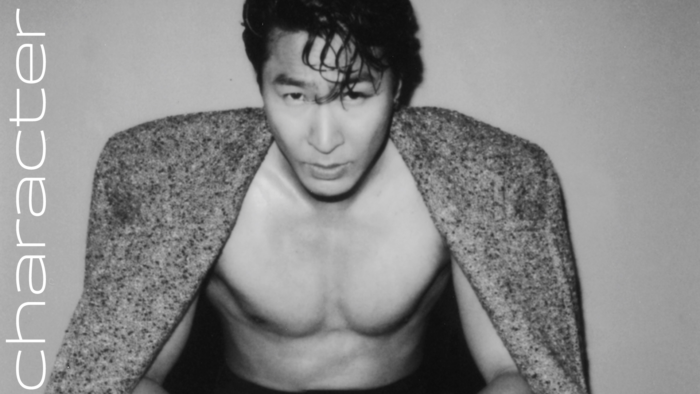

Coat – Bottega Veneta Shorts – Bottega Veneta Ring – Mejuri Socks – Falke Shoes – Grenson
After winning audiences over with his charm in Crazy Rich Asians, Chris Pang is embracing a bold new character in Hulu’s The Season. As the outspoken and sharp-tongued Andrew Fung, Pang steps away from the “nice guy” roles that have defined his previous characters, revealing a darker side to his acting range.
Producer: ALEKSANDAR TOMOVIC (Publisher) alekandsteph
Photography: ASHLEY SERYN @ashleyseryn
Styling: CHRIS B. @chrisbkim at @aframe_agency
Grooming: SONIA LEE @sonialeeartistry at @exclusiveartists
Publicist: CASSANDRA QUARTO at Platform PR @platformprteam
Production Assistant: ALBERTO GONZALEZ @alberto_filmdirector
Production/Location: Bello Media Group X Maison Privée
8285 W Sunset Blvd., WeHo, CA 90046
CHARACTER: The Season offers audiences a fascinating look into Hong Kong’s elite social circles, where appearances often hide deeper truths. What was it about Andrew Fung that immediately drew you to the role, and what did you discover about him that wasn’t obvious on the page?
CHRIS PANG: The Season lives in that grey area – the in-between space. People aren’t wholly good or completely bad, they land somewhere in the middle. And of all of them, Andrew is the character who hides himself the least. He’s abrasive, loud, unpredictable, and he speaks his mind from the very first moment. He’s one of those people who has no inner voice and outer voice – he just says what he thinks. I found that so refreshing.
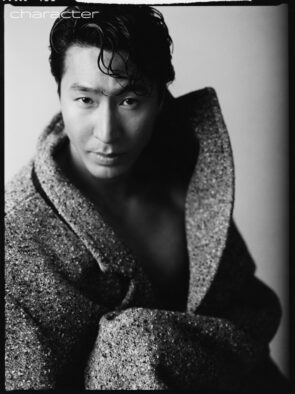
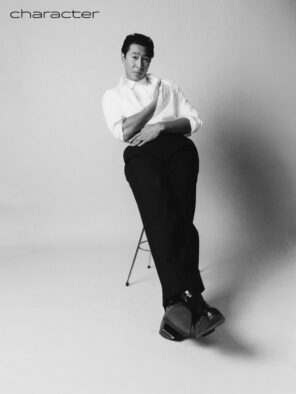
LOOK 1: Coat – Bottega Veneta Shorts – Bottega Veneta Ring – Mejuri Socks – Falke Shoes – Grenson LOOK 2: Two Shirt – goodfight Trousers – goodfight Boots – Bottega Veneta Ring – Mejuri
I’d never had the chance to play an asshole before, and I can tell you it was a lot of fun. But what’s really beautiful about Andrew is that beneath all of that, as the series goes on, you discover a softer, sweeter side to him – one he’s almost afraid to show. And in those quieter moments, I think he becomes one of the most likable characters in the series.
C: Andrew is charismatic, confident, and at times deeply flawed. As an actor, how do you find empathy for a character who isn’t always easy to like, and why do you think audiences are often drawn to those kinds of people?
CP: Oh, those are my favourite characters! There’s something in us as humans that just enjoys watching flawed people. If someone is too perfect, we get suspicious – we assume they’re hiding something.
My job isn’t to judge a character, my job is to embody one. To understand what makes them tick and get inside their mind. So finding empathy is very easy for me, because I’m not looking at them from the outside – I’m coming from their perspective. And from in there, there’s no such thing as a villain. You’re always going to be the hero of your own story.
C: You’ve spoken about wanting opportunities to break away from the “nice guy” roles audiences have come to expect. Did The Season feel like the creative challenge you had been waiting for, and how freeing was it to explore a more morally complicated character?
CP: Yeah. Maybe it’s because I naturally have a darker sense of humour, so when I’m playing nice guys the kind of fun I can have with it is very specific, and less appealing to me. Whereas –
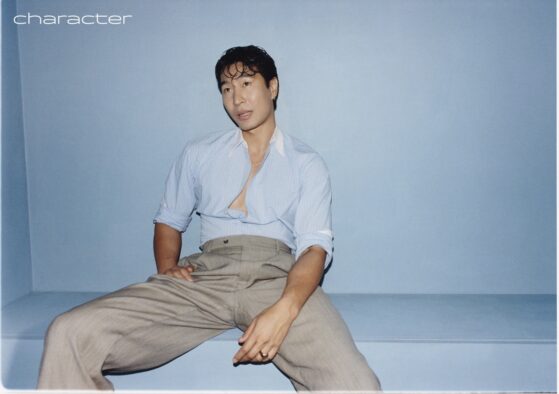
Shirt – Acne Studios Trousers – Givenchy Shoes – Florsheim
and I don’t know what this says about me – I feel like I can’t help having more fun with despicable characters. I like watching them, too. Whenever there’s a show with one guy who’s a massive idiot, he’s probably going to be my favourite character. Maybe it’s just so much more fun being bad.
I think as actors we’re all intrigued by the human condition, and it’s always more interesting to play characters who are morally ambiguous, who have more going on than meets the eye. When you’re playing someone with darkness inside them, you can juxtapose that against the light, and that’s when it becomes interesting. Maybe it’s a bit like real life, the way people go for the bad boys. There’s that saying “nice guys finish last” – maybe they’re just not as interesting.
C: From Crazy Rich Asians to The Season, you’ve helped bring contemporary Asian stories to global audiences in very different ways. How have you seen representation evolve over the course of your career, and where do you think the industry still has room to grow?
CP: I think we’ve finally been given permission to tell authentic stories. There was a time, especially when I was small, when Asian characters were all stereotypes, and that was very damaging for Asian kids trying to find their identity. More recently we’ve been allowed to tell our stories in a way that’s led to much better and more widespread representation.
I think the next step for us is to build the relationship with our community – a community that will come out to support the projects and the filmmakers making the films our community actually wants to see. We’ve been somewhat confined to smaller budgets, restricted in what kind of movies we’re able to make. It’s our job now to find ways to create our own Asian stars and build the vehicles that launch those careers outside the studio system.
The goal is that regardless of what kind of Asian you are, or what kind of personality you have, you’re validated by seeing yourself represented in media. A whole spectrum of Asian characters out there – so that kids can grow up proud of who they are.
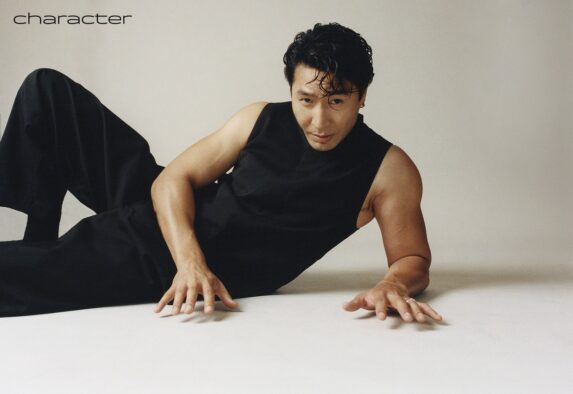
Vest – Dior Trousers – COS Shoes – Dior Ring – Mejuri
C: The series is set against the glamorous backdrop of Hong Kong, but beneath the luxury it explores themes of ambition, identity, and belonging. Which of those themes resonated with you the most on a personal level while making the show?
CP: Identity and belonging, definitely. And for me they’re both linked to Hong Kong. I grew up watching Hong Kong cinema. That’s where I found all my heroes, that’s where I learned to connect with my culture, and it was integral to me getting in touch with my identity. So Hong Kong has always been very special to me and getting to shoot there was a literal dream come true.
It’s such a beautiful, romantic city and we really show it off in the series. But it’s personal beyond that. I started my acting career in Hong Kong in 2009, knocking on doors, handing out my
résumé to anyone who’d take it. So to come back now and be shooting a show for Hulu is a full-circle moment for me. Hong Kong really has shaped who I am.
C: Every project leaves actors with something they didn’t have before. Whether it’s a new perspective, a skill, or a greater understanding of themselves, what did you take away from filming The Season that you’ll carry into your future work?
CP: To be honest – and this may sound a little abstract – shooting in Hong Kong left me with something I didn’t know I needed. Just being there, surrounded by a culture I could identify with and felt close to, being around people who looked like me, where I didn’t feel like an Asian man, I just felt like a man. That really fulfilled a part of me. It nurtured a part of me I didn’t know needed nurturing. It just felt really nice.
So I think it’s reactivated the part of me that wants to get in touch with my culture and be more present in Asia. I’d always resisted Asia to a certain extent, because of the importance I’d placed on making my mark in Western media. But this experience has really opened me up to the idea of it.
C: Your career has crossed Australian, Asian, and Hollywood productions, giving you a uniquely international perspective. How have those different industries shaped your approach to storytelling, and do you find yourself adapting depending on where you’re working?
CP: Even though I’ve worked in those different places, the productions I’m on are generally international productions, so I haven’t found the need to think or adjust for a more local tone or flavour. At the heart of every project worth doing, regardless of where it’s filming, is the human condition. That’s international. That’s a universal language we all understand. So I’ve never felt the need to change my approach for a specific territory.
One thing that was very different about filming in Hong Kong, though, was having my mother tongue spoken all around me. Being on a set and hearing Cantonese everywhere was special. And the food was so good! I didn’t even want the fancy actor food they give us – I just wanted to know what the crew was having. Roast duck and roast pork all day. It was the best.
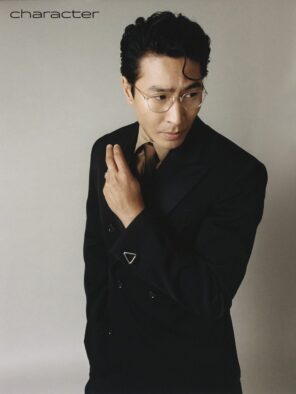
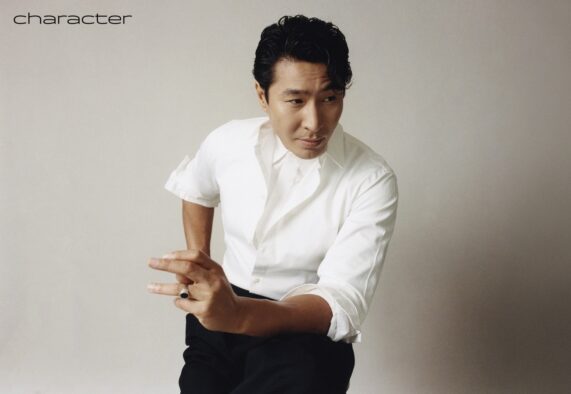
Suit – Bottega Veneta Shirt – goodfight Shoes – Bottega Veneta Tie – The Tie Bar Ring – Mejuri Glasses – Oliver Peoples
C: Audiences first fell in love with your warmth and charm in Crazy Rich Asians, but Andrew in The Season reveals a completely different side of your range. Are there still types of characters or genres you feel people haven’t seen you explore yet?
Oh, absolutely. As an artist you’re always trying to broaden your horizons, and you’ve got this natural inquisitive streak that keeps you learning. You’re always a student of the craft. So there are many roles I haven’t played that I’d love to.
Right now I’m going through an action phase, and I think I actually strayed too far away from it. Both my parents teach martial arts – they’re kung fu teachers – and almost nobody knows that,
because when I started out I didn’t want to be typecast as a martial arts actor. So I ran the other way. I’d love to come back to it now. And I want to do dirty, dark, gritty thrillers. That’s what I love.
I’m also about to start shooting an indie film playing a bisexual man that will be very confronting for me, which is exactly why I’m doing i t- it’s the chance to explore something completely new and broaden my horizons. That’s really the fun of being an actor.
C: You’ve built a career by embracing opportunities that challenge expectations rather than simply repeating past successes. When you’re reading a script today, what makes you say, “This is a role I have to play”?
CP: Being an actor is already quite a selfish career – it can feel like we always want more, we’re always expecting more. But the honest answer is: I’m looking for all the standard things. I want a great character. I’m looking for great writing. I want to be involved in a project with a philosophical message, one that says something and is in line with my passion. And my mission, really, is to bring Asian culture to the world – but in the right way, in a positive way. If all of those things line up, that’s the perfect role for me.
And then it’s the opportunity to work with great people. Filmmaking is a collaborative effort, you can’t do it on your own, so working with great filmmakers and great scene partners is always the goal. Specifically right now, though, I want to move away from the light-hearted stuff and start doing more serious roles. The big-boy roles.
C: Looking ahead, what kind of legacy do you hope to leave—not only as an actor, but as someone helping shape how Asian stories and characters are seen on screen around the world?
Growing up in Australia, I never saw myself reflected on screen in a way that made me proud to be Asian. It actually did the opposite. I felt very insecure about the way that I looked, and it was very difficult for me to come to an understanding of who I was and where my place was in Western society.
So it’s always been my goal and my mission as part of this industry to affect it in a way that changes that for the kids growing up today. I want to portray characters that feel authentic and that represent my culture on screen, so that any kid growing up now might see themselves, feel validated, and feel like they belong in a way that I never did.

Full Look – FALGUNI SHANE PEACOCK Shoes – Bottega Veneta