
Text and photographs by Mark Edward Harris
Few lands have been more devastated by war and conflict than 20th-century Korea. Yet the perseverance of the peninsula’s people has maintained for posterity many of its cultural institutions and historical structures.
I started my exploration of South Korea’s rich history with a visit to the tomb of Sejong the Great in Yeoju, Gyeonggi Province. While so many world leaders are associated with conquests and wars, it’s inspiring to learn about a leader who gave—instead of took—to earn his fame. He is, of course, most known for developing Hangeul, the modern Korean phonetic writing system that brought reading and writing to the masses.
After paying my respects to Sejong the Great, I continued my exploration—with camera in hand—of the royal tombs of the Shilla Dynasty and the palaces of the Joseon period.
 The tomb of King Sejong the Great.
 A door detail at Bulguk Temple.
 The magnificent roof of Injeongjeon, the throne hall of Changdeok Palace in Seoul.
 At the Korean Folk Village in Yong-in, red peppers are laid out to dry. Kimchi did not acquire its spiciness until red peppers arrived on the Korean peninsula aboard Portuguese trading ships during the 16th century.
 Attendants groom the grass covering a Shilla tomb in Tumuli Park in Gyeongju.
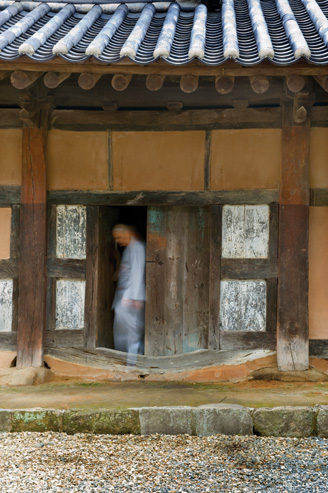
 A monk exits through an ancient door at the Seonam Temple complex at the west end of Mt. Jogye.