Kevin Haebeom Vollmers founded the online magazine Gazillion Voices, so that adoptees like himself can help shape the discussion around adoption issues.
by JAMES S. KIM
The Land of Gazillion Adoptees blog, as popular as it was, was never meant to last. That is to say that its founder, Kevin Haebeom Vollmers, a 36-year-old Korean American adoptee from Minnesota, always had in mind bigger goals for the online adoptee-centric space, started in the summer of 2011. And, as the blog continued to thrive, bringing important topics and views in the adoption community to the forefront, Vollmers and his team slowly began laying the groundwork for the next stage in evolution: Gazillion Voices.
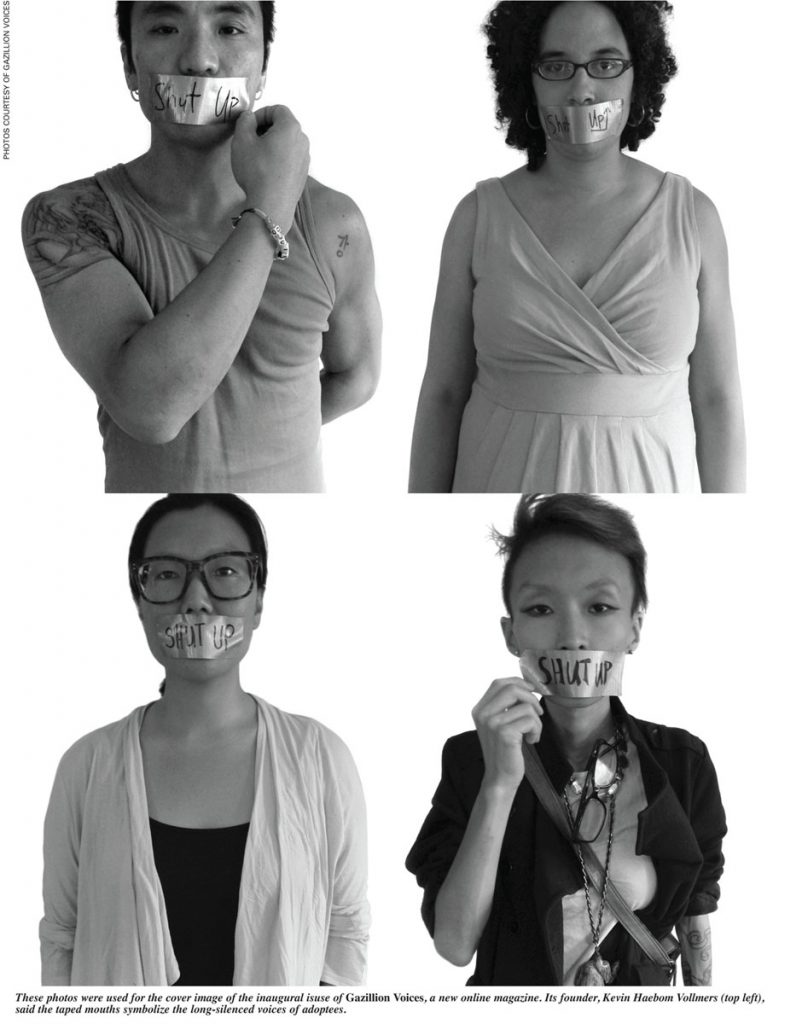
After a successful Kickstarter campaign that saw total pledges exceed the original goal of $15,000 by over $3,000, the team launched the first issue of the subscription-based, online-only magazine in August 2013. The inaugural Gazillion Voices featured a two-part cover story, “Ripping the Tape Off,” by Mary Martin Mason and Joy Lieberthal Rho, who shared their stories and views on how far adoption issues have come in mainstream discourse.
Subsequent issues have delved into such topics as destructive behaviors in adult adoptees and the “Baby Veronica” case, involving the four-year custody battle over an American Indian baby between the child’s biological father and white adoptive parents. The magazine also includes podcasts, photo essays and video interviews with adoptee artists, authors, chefs and scholars who research adoption.
When Vollmers spoke to KoreAm last month, Gazillion Voices was three issues in, and future prospects for the publication looked promising.
“[Our readers] think it’s an improvement every month,” he said. “We know that we have some good things coming up over the next few months, as well as a few surprises.”
Starting a for-profit publication in this day and age might seem a bit risky, but Vollmers is confident he and his team already laid the groundwork with its predecessor, the Land of Gazillion Adoptees blog.
“We really wanted to elevate the voices of adoptees, which is very similar to what we were doing on the blog,” he explained. “We feel that in this phase, there are so many incredible adult adoptees doing incredible research [in different fields].”
Increasing discussion is only half the goal. The other is to change how the conversation is currently shaped. Though adoption is a popular topic in the media, Vollmers pointed out that the media often goes to adoptive parents, institutions, agencies and policymakers for commentary. The irony, he says, is that the media doesn’t seek out the expertise of adoptees, even though adoption affects them the most.

“Adoption is a lifelong thing, and adoptees grow up, they have kids, they have their own professions, and many of them decide to home in on adoption or race issues, or become activists,” Vollmers said. “In many respects, they have as much knowledge as anybody else. We have a publication that focuses on that idea, that on the one hand, should be a no-brainer, but on the other, it really isn’t for many people. … It’s a challenge because it’s not the way people think about adoptees in general.”
Adoption requires a critical perspective because there are so many complex aspects and layers to the issue. Such topics as foster care kids languishing in the system and South Korea remaining one of the major sending countries in the world are just the tip of the iceberg.
That latter issue is quite a personal one for Vollmers, who was adopted by a family in rural Minnesota at the age of 7 in 1984, after his single mother struggled to raise him following his father’s death. Because his parents were not formally married, his mother faced rejection from both society and family. She died in 1985 from heart issues.
“What gets to me now … is that the experiences of my mother in South Korea are reflected in the lives of single women and parents in South Korea today,” Vollmers said. “I would love to see South Korea put more emphasis on supporting the women who decide to parent, so that they do not feel compelled and pressured by society and their families to place their kids for international adoption.”
Vollmers grew up with two sisters who were also adopted from Korea, and despite Minnesota having a large Korean adoptee community, he said many of these individuals grew up isolated. His two sisters were his only Korean “context,” and he said that he had a difficult upbringing that he does not want other adoptees to endure.
“I grew up ‘white,’ internally [wrestling] with the loss of my mother,” he said. “I still do, and I didn’t start embracing my identity as a Korean American until well into my 20s. My experience isn’t unique, and I believe that adoption agencies need to end the practice of placing domestic and international adoptees of color into mostly white communities.”
In 2012, the South Korean government passed the controversial Special Adoption Act that explicitly discourages sending Korean children abroad for international adoption. Vollmers and other adoptee activists, who had advocated for the South Korean government to focus its efforts on helping single mothers who want to keep their children, have deemed it an important step. Although overseas adoption began as a type of social welfare program for abandoned mixed-race children following the Korean War, it continued going strong long after the country emerged from its post-war poverty.
In fact, overseas adoption—to North America, Europe and Australia—peaked in 1986, just two years before South Korea hosted the 1988 Summer Olympics. As adult adoptees like Vollmers and others have advocated for policy changes, that figure has declined in recent years, with 755 children adopted by overseas families in 2012. The Ministry of Health and Welfare is projecting about 300 international adoptions this year.
Vollmers, along with other Korean American adoptees, was quoted recently in a CNN piece about South Korea’s shift in adoption policy.
Now that he himself is the parent of two children, ages 5 and 2, Vollmers said there’s a completely new perspective when thinking about his adoption experience.
“I was two years older than my son when I came to the U.S.,” he said. “And I cannot for the life of me think about what kind of impact it would have on my child if he, right now, [at] 5 years of age, was removed from his country of origin and placed into a completely strange setting.
“It has forced me to think about my origins, as well as what he thinks. … My son has seen my mother’s grave, and that forced me to think of what my relationship with South Korea was.” Vollmers called it a travesty that the Korean American community isn’t talking more about the adoption issue. That’s why, as adoptee-centric as Gazillion Voices is, it’s not meant just for an adoptee audience. It’s meant to inform, educate and engage the public at large.
“We also want to get adoption and adoptees in particular out of its community,” Vollmers said. “It’s very much within a shell, and adoptees have been in their shells, as well. This whole silo effect—of when you have like-minded folks talking about very similar things and sharing similar experiences and not going outside of itself, in many respects—hinders everybody involved.”
He thinks the adoptee community has been silenced for too long, or their voices marginalized. “I think the discourse has evolved a bit more, but simultaneously, there needs to be a lot more work done, whether it’s from critical-thinking adoptees or adoptive parents or institutions,” said Vollmers.
“I’m very much of the idea that it’s the adoptees’ time to lead.”
This article was published in the November 2013 issue of KoreAm. Subscribe today! To purchase a single issue copy of the November issue, click the “Buy Now” button below. (U.S. customers only. Expect delivery in 5-7 business days).