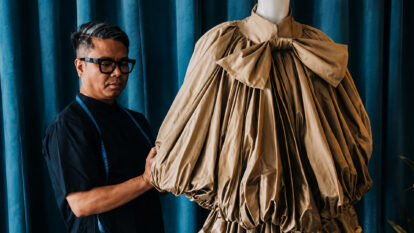

Vicky Tsai’s path to founding Tatcha is rooted in transformation, shaped by personal health struggles, cultural rediscovery, and a search for meaning that ultimately redefined her relationship to beauty itself. After leaving a high pressure corporate career that took a toll on her physical and emotional well-being, she found healing in Japan, where ritual, philosophy, and tradition offered a radically different way of understanding care and self-worth. What began as a personal journey evolved into a global brand built on heritage, mindfulness, and intentional living. This conversation explores how she turned vulnerability into vision, and how Tatcha became both a reflection of identity and a reimagining of what beauty can stand for today.


Photo Credits: Kenneth Medilo
You’ve spoken about leaving a successful corporate career because it lacked meaning. Looking back, what did that decision teach you about honoring your own instincts over outside expectations?
After years of working in the corporate world, city life, stress and heavy travel took a toll on my physical and mental health. I wore my stress on my skin, which took the form of dermatitis on my face as well as eczema and hives on my body. I realized that in order for my life to feel meaningful, my work also needed to have meaning. Like many people, I began to travel to find myself. I began traveling in search of inspiration. I found it in Japan’s cultural and spiritual center, Kyoto. Not only did the beautiful ingredients and timeless rituals heal my skin, but the philosophies around living in harmony with self, community, and nature gave me practices that uplifted my soul. Early on, I was told “Asian beauty is not aspirational in the U.S.” But my team and I believed in what we were doing and just focused on our craft, our clients, and in building a company that we could be proud of. We built a brand rooted in heritage and the beauty rituals, proving that honoring your instincts can be a strength in business. I learned that anchoring your work in purpose is what creates lasting impact. When your business or career is driven by a deeper mission, whether it’s representation, community, or well-being, it not only fuels your passion but also inspires and uplifts those around you.
Tatcha was born from a deeply personal struggle with your own health and skin. How did that vulnerability shape the way you built the brand, not just as a business, but as a philosophy?
For so long, the beauty industry has taught women to see themselves as something to be fixed, an endless project, never quite enough. It creates a quiet adversarial relationship with our own bodies. In Japan, I encountered a completely different philosophy. I learned to see my skin not as a problem to be fixed, but as something precious that reflects and affects our inner health. The Japanese approach to holistic health healed my skin and reshaped my mindset, showing me the power of balance and intentional living. I was finally convinced to slow down and reconnect with myself, and I knew I needed to share that feeling with others. That’s how Tatcha was born, with the purpose of inspiring self-love through ritual, care, and education. I wanted the brand to be able to take care of people through their skin, and help people see skincare as a catalyst for health and wellbeing. The Japanese have a phrase, hinou-dokon, that translates to “skin mind same root,” and describes the belief that caring for the skin is caring for the mind. Your skin actually reflects and affects your mental state. Our research into the skin mind connection and the power of presence has greatly impacted our approach to formulations, and I’m constantly inspired by ingredients that are proven to deliver multiple benefits for our overall well-being, whether they’re mental, physical, or emotional. Since Day One, our scientists at the Tatcha Institute in Tokyo have been constantly innovating within tradition, committing to crafting formulas that address the whole person, not just the surface.
Your work bridges heritage and modernity, especially through Japanese rituals and your own cultural identity. How has your perspective on identity evolved since launching Tatcha?
For a long time, I didn’t see myself represented in the beauty world. Previously working in the beauty industry, I was constantly surrounded by messaging that created and capitalized on insecurities, telling women that they needed to fix themselves to be beautiful. Over time, I internalized these messages and felt like I was never enough. It eroded my sense of self-worth. The irony is the more I bought into conventional beauty, the worse my skin health was. It wasn’t until I began studying with geisha in Japan that I realized that beauty is about health, and that beauty rituals can be healing and not harmful. The modern geisha I met in Kyoto introduced me to the gentle, time-tested ingredients based on the Japanese diet that she used on her own skin. I ended up at a little store, where I saw geisha filing in and out with their beauty necessities, these bell jars full of waxes and oils and powders that I had never seen before in the Western world. So of course I bought some of them, and after about eight weeks, my skin had completely healed. At the time, I thought the ingredients were the secret to my transformation, but now almost fifteen years later, I realize it was much deeper than that. As an Asian American woman, I’ve often struggled with my identity. In Asia, I’m seen as American. In the United States, I’m seen as Asian. I’ve been asked, in many ways, “What are you?” because the world often wants you to fit in a box. Tatcha has lived in that same space. Rooted in Japanese traditions and craftsmanship, created with a Japanese founding team, made in Japan, yet founded by me, an American of Taiwanese descent. Like me, the brand doesn’t fit neatly into a single category. But over time, I’ve come to see that not as something to resolve, but as something to honor. Human beings are so multifaceted and are not meant to be one thing. We are shaped by the cultures we come from, the ones we step into, the people we meet, and the experiences that stay with us. Our identities are not singular, they are layered, evolving, and deeply personal. I’m proud to be Chinese American and proud for Tatcha to be a modern luxury Japanese beauty brand, inspired by a meeting of worlds. That duality has shaped who I am, and who we are as a brand. As a daughter of immigrants, I once believed belonging meant fitting into a single box. Life has taught me otherwise. We are not meant to be reduced, and our identities are a rich tapestry of our cultures and lived experiences. The more you live and learn, our duality and complexity make us who we are.


Photo Credits: Kenneth Medilo
Building a company of that scale often comes with invisible costs. How do you define success today compared to when you first started in your early 30s?
There is an invisible cost to creating something out of nothing. When I first started out, I had always worked 80 to 100 hour weeks, there’s no question about that, but it was simply what the work required. That comes at a cost. But for me, it was never a question of whether it was worth it. Tatcha was never just a career, or a way to make money. It has always been my life’s work. It’s rooted in a deeper purpose, the honor of helping people feel cared for through their skin, of building a company where incredible people can grow and thrive, and of knowing that, if we do our jobs well, we can help change futures through our partnership with Room to Read. So yes, there were sacrifices, but there is also profound meaning in being able to do this work. What I didn’t expect when starting Tatcha was how deeply it would help me understand my own identity and purpose. In Japanese, there’s this word, ikigai, that speaks to the things that fuel you and fill your life with meaning. Historically, the beauty industry has diminished a woman’s sense of self-worth. I wanted Tatcha to be a platform for change, a source of care, authenticity, and empowerment. That’s why we created our Beautiful Faces, Beautiful Futures program in partnership with Room to Read in support of girls’ education. As of February, our clients have helped us fund over 14 million days of school for girls around the world. Every time clients care for their skin with Tatcha, they are making the most positive impact possible. My hope is that Tatcha continues to be a force for good, not only in how we care for skin, but in how we uplift communities and redefine what beauty can stand for in the future.
You’ve been open about burnout, healing, and redefining leadership. What does a sustainable version of ambition look like for you now?
I started my career on Wall Street and was in a building adjacent to the Twin Towers on 9/11 when the planes hit. After that, I had to return to the area day after day for work. It took a toll on my well-being. My husband at the time was also in the same office building and developed an autoimmune disease that wreaked havoc on his health for three years. I soldiered on, not realizing the toll that the experience had on my mind and body. It was compounded by a decade of high stress work in corporate America. Eventually, the stress presented as inflammation in my body, most notably my skin. I developed acute dermatitis, which meant bleeding and blistering on my face, lips, and eyelids unless I used almost daily oral and topical steroids and antibiotics. For a long time, my instinct was to treat the symptom and not look inward to find the root cause. I was always pushing forward, without pausing to check in with myself. But what I learned through healing and the Japanese approach to holistic health is that true well-being requires balance and intentional living. I was finally convinced to slow down and reconnect with myself, and I knew I needed to share that feeling with others. Sustainable ambition, for me, is no longer about pushing harder, but about creating space for that presence, understanding that caring for yourself is not separate from your work, but essential to it. That experience really reshaped how I define ambition. When I was younger, it was all about what I could achieve, defined by traditional metrics of success, title, compensation, climbing up the corporate ladder. Now, I could not care less about those things, but I find myself more ambitious than I have ever been, just in a deeper, more purposeful way. Ambition to me now is about what I can help achieve in my lifetime. I’m honored to be on the global board of Room to Read, whose mission is to end illiteracy and gender inequality in our lifetime. That is the kind of ambition that calls you forward, the kind that asks not just what you can accomplish, but what you can contribute. In this case, it is to make sure that children have a chance at a beautiful life. What makes this ambition sustainable is a quiet understanding that the greater the challenge, the more it asks of your presence, patience, and care for yourself along the way. It is a balance of urgency and grace, a willingness to move forward with intention, one day at a time.
You launched Tatcha at a moment when the industry told you it was “too niche” and “too exotic.” What gave you the conviction to move forward anyway?
As an Asian American, I could feel the weight of cultural biases in corporate America. Investors did not believe that a luxury skincare brand rooted in Japanese heritage, founded by an Asian American woman, could succeed. I heard things like, “Asian brands do not sell in the U.S.” or that there was not a market for what we were doing. Even though I had a Harvard Business School degree, a business background, a product, press, and two acquisition offers within months of launching the brand, I could not raise capital from the investment community for years. But I knew what I had seen in Kyoto, and I believed in the beauty and wisdom of these traditions. So I sold everything I could, my engagement ring, my car, my home, to build it without institutional capital. I founded Tatcha alongside a team of Japanese skincare scientists, geisha, monks, and cultural advisors who are still with us to this day. They showed me a philosophy of care that healed my skin and spirit. One of the concepts that stayed with me is wa, or harmony, the idea of living in balance. Balance between body and mind, between yourself and others. I do not think it is a coincidence that, as the world becomes more complex and overwhelming, so many people feel drawn to places like Japan, cultures that are deeply rooted in tradition and wisdom. In moments where we feel that we are in crisis or lost, we instinctively seek out something that feels grounding, cultures that seem to be steeped in wisdom. For me, that experience created a quiet but unwavering conviction. I believe, because I had lived it, that these philosophies could help others too. I have always considered myself fairly ordinary in what I have gone through and what I have searched for as a human being. I felt that if something could reach me in that way, it had the potential to reach and resonate with so many others.


Photo Credits: Kenneth Medilo
You became a mother at the same time your business was coming to life. How has motherhood influenced the way you lead, create, and prioritize today?
Motherhood has made me a better leader. Early in my career, I believed leadership was about control, knowing everything, having all the answers. But over time, I have come to understand that true leadership is not about control, but about influence, about inspiring, guiding, and teaching in a way that allows others to grow. As your company gets bigger and there are more people, you naturally lose control, so all you can do is influence. That is what motherhood is. When your child is a newborn, you have a certain level of control, but as any mother will tell you, you start losing control when they are toddlers. As they grow, they begin to reveal who they are, independent, strong willed, and entirely their own person. And you realize that control was never the point. What is required instead is empathy, learning to see the world through their eyes and meeting them where they are. At the end of the day, my role as a mother is not to shape every outcome, but to help instill a value system in my child, to nurture resilience and self love so they can navigate the world on their own. That is how I think about my role at Tatcha. I cannot control this company any more than I can control my sixteen year old daughter, but I can help remind our team why we exist and of our value system. I can return us to our purpose, to what gives us ikigai, our sense of purpose. I can offer guidance when it is needed, encouragement when it is helpful, and space when it is not. To me, motherhood and leadership are identical. Both ask you to lead with patience, with humility, and with love, and to trust that what you nurture will find its own way forward.
What’s your “Call Your Shot” moment, when did you decide to go after something and refuse to let uncertainty stop you?
In my early 30s, I remember sensing an invisible ceiling above me, though at the time, I did not have the language or explanation for it. In 2021, when doing research in support of the AAPI community, I came to understand the concept of the “bamboo ceiling.” But back then, I simply assumed the limitation was something wrong with me, that I simply was not enough. I knew that being in an environment where there was no opportunity for success meant there was a 100 percent chance that I would be unhappy. I could contort myself to fit in, but the better my resume looked, the more disconnected I felt from my own authenticity and self worth. If I stayed, the outcome felt guaranteed. If I bet on myself to create something of my own, something rooted in purpose, there was uncertainty, yes, but also possibility. There was a 50 percent chance that I would fail, but there was also a 50 percent chance that I would find happiness and a deeper sense of fulfillment. In that moment, the choice became clear. The unknown, even with its risks, held more hope than the path I was on. So in the simplest way, the odds were in my favor, and I took the leap.
Vicky Tsai
Photographed by Kenneth Medilo @kenmedilophoto
Styling + Creative Direction Benjamin Holtrop @benjaminholtrop at @thewallgroup
Hair & MUA Brittany T, Nikki L, Kelly T, Kahn at @KellyZhangAgency
Production Aleksandar Tomovic @alekandsteph
Socials Tesia Kuh @thefirstthree.co
Production Coordinator Chalisa Phiboolsook @chalisaphi
Talent Coordinator Isabella Nuqui @_snowdust_
Location BELLO Media Group x Maison Privée @BELLOmediaGroup @maisonpriveePR_LA