Nearly 25 years ago, John Cho appeared in a movie that helped change the possibilities for Asian American actors in Hollywood.
Justin Lin’s “Better Luck Tomorrow” arrived at Sundance in 2002 with a story about Asian American teenagers that Hollywood simply wasn’t telling at the time. Its characters weren’t expected to represent their community or conform to the stereotypes typically assigned to young Asian men onscreen. They were allowed to make bad decisions, and the movie didn’t feel obligated to apologize for them. When an audience member famously challenged Lin over the film’s portrayal of Asian Americans at Sundance, Roger Ebert stood up to defend the filmmakers’ right to tell that story.
Cho was still early in his career at the time, although audiences had already noticed him in “American Pie.” In the years since, he has become one of the most recognizable Korean American actors in Hollywood. “Harold & Kumar Go to White Castle” made him a leading man in a studio comedy at a time when that was still exceedingly rare for an Asian American actor. He took over the role of Hikaru Sulu in J.J. Abrams’ “Star Trek” films and later carried the thriller “Searching.” Smaller films have given him some of his best material, particularly Kogonada’s “Columbus,” where Cho’s understated performance showed another side of an actor many audiences first knew through comedy.
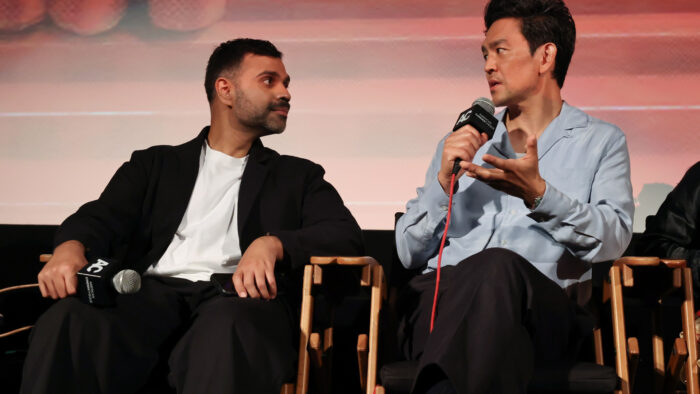
Bassam Tariq’s “Your Mother Your Mother Your Mother,” now playing in select theaters before expanding to additional cities beginning October 2, gives Cho something different again. He plays Pastor Hwan Yoon, a Korean American faith leader in Texas who becomes an adversary to Latif, played by Mahershala Ali. Latif is a contract killer whose Muslim faith has allowed him to create a moral code around the violence he commits. After the death of his wife, he is left raising their children while trying to leave that life behind. Hwan and the militia growing around him make that increasingly difficult.
Hwan makes quite an entrance. Cho’s hair is bigger, his clothes are louder and his easy charisma can make it tempting to laugh along with him. Then the threat underneath begins to show. The character could have easily tipped into caricature, something Cho was conscious of when he first read the script. He wasn’t even sure what Hwan should look or sound like. Tariq’s response was simple: they would figure him out together.
That process eventually included Ali. Cho, Tariq and Ali talked about their own backgrounds and beliefs while working through who Hwan was and where his faith came from. Tariq also wanted the character to be specifically Korean American, which led them to think about what Hwan’s upbringing in Houston might have looked like. The specificity mattered because Cho had no interest in treating him as a convenient villain.
“I didn’t want to judge him,” Cho told Character Media. “I didn’t want to make a political statement. I wanted to make a character statement and an emotional statement.” For Cho, the relationship between Hwan and Latif only worked if the audience believed both men meant what they said. “I wanted this to be about two authentic believers who collide with one another. I didn’t want it to be about two religions colliding.”
The role arrives at an interesting point for Cho, particularly with the 25th anniversary of “Better Luck Tomorrow” approaching. Hollywood has changed considerably since that film premiered, but Cho doesn’t talk about his career as if he has crossed some clear line from limited opportunities into better ones. “It’s never felt like I was on the bad side and now I’m on the good side,” he said when asked about the evolution of Asian American representation. “It’s never been binary like that.”
What interests him now is the work itself. After almost three decades onscreen, Cho says he feels like he is still figuring out what kind of actor he can become. “In some ways, I feel like I’m just coming into my own as an actor,” he said. “My objective really is to go deeper.”
I spoke with Cho about creating Hwan with Tariq and Ali, why he didn’t want to judge the character for what he believes, working opposite Ali on a story so rooted in faith, and why nearly 25 years after “Better Luck Tomorrow,” he still feels like he’s getting started.
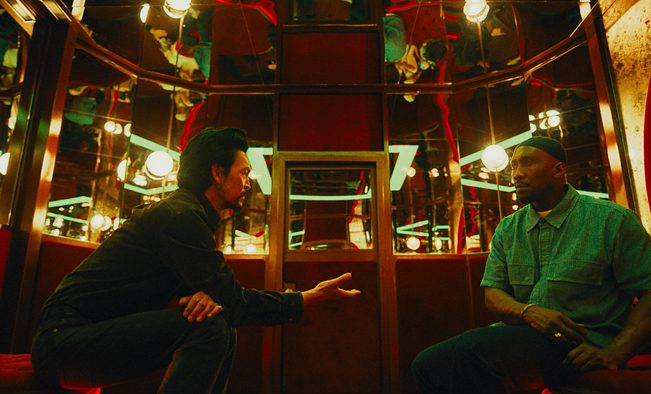
Ben Lei: Pastor Hwan is funny and charismatic, but there’s also something dangerous underneath. How did you find that larger-than-life look and personality, and how did that help you find the balance in the character?
John Cho: It was definitely a collaboration because when I closed the script, I wasn’t sure how to do this. I wasn’t sure how the pastor would present, what he looked like or sounded like. I didn’t know where exactly he came from. It was tough to make assumptions.
It was Bassam who said, “Let’s build this guy together.” Then we widened out to Mahershala. We spent time talking about our pasts and our beliefs. Bassam was also very keen on making him very specifically Asian American, Korean American. So we talked about what it would have been like to grow up in Houston in this milieu, and how he got to where he got.
BL: You’ve said there were potential pitfalls in playing this character. What were you most careful about avoiding?
JC: I didn’t want to judge him. I didn’t want to make a political statement. I wanted to make a character statement and an emotional statement, and I wanted him to be an authentic believer in what he was doing.
I wanted this to be about two authentic believers who collide with one another. I didn’t want it to be about two religions colliding.
BL: You and Latif are on such opposite sides, but as you said, they’re both men of very deep conviction. What did you enjoy about exploring that dynamic with Mahershala?
JC: He is a person who brings his own faith to his work. It felt like a person who was going to come at this discussion from an intellectual perspective, a spiritual perspective and a lived perspective.
With this partner, I felt confident. I didn’t feel fear going into this thematic territory. I felt like, with Bassam and Mahershala, the film would project their personalities, which are respectful and thoughtful.
BL: One of the early reviews out of TIFF said something along the lines of, “John Cho is just having a blast in this role.” Did it feel that way? Was this one of the more fun roles you’ve had the opportunity to play?
JC: I look back and I think of it less as “fun.” It was fun, but it wasn’t like teacups-at-Disneyland fun.
I think of it as a very immersive, intense experience. The adjective I would use is more fulfilling and satisfying, being in collaboration with people who are really on a mission to make the best story possible. When you’re in community with people like that, it feels really fulfilling. That’s all I can say about it.
BL: Apologies if this question makes you feel older, but we’re coming up on the 25th anniversary of “Better Luck Tomorrow,” which was such a groundbreaking film for Asian American representation. At this point in your career, what roles still feel new to you as an Asian American actor? Do you feel like more of those opportunities exist now than when you started?
Cho: In terms of Asian American representation and the questions as it relates to my career, it’s never felt like I was on the bad side and now I’m on the good side. It’s never been binary like that.
It has always felt like just trying to expand and stay in it and get better. I think part of that is probably getting older and getting better and getting more out of the parts that are given to me.
The sum of it is, I just want to keep going. In some ways, I feel like I’m just coming into my own as an actor. I’m lucky to still be here. I’m very appreciative of it and not taking those things for granted.
My objective really is to go deeper. More than the question of variety, it’s like, can I just get better and deeper as the years go on? That’s what I’m thinking about.
BL: Bassam has talked a lot about grace and mercy as being central to the film. Did Hwan understand those ideas in his own way, and did playing him allow you to get to some of that deeper territory you’re talking about?
Cho: There’s a moment toward the end of the film when Latif and Hwan are both confronting an event that they’re struggling to explain. In the moments after this fight, they’re struggling individually to come to terms with that event alongside the person they were, moments ago, in a life-or-death battle with.
I’m not even sure what I take away from that, except that it was very satisfying to portray two strong-headed, faithful men holding something that they don’t know what to do with. I don’t know. That was dramatically cool to depict.
BL: I appreciate your time. Thank you so much. The film is amazing, and I can’t wait for the rest of the world to get to see it.
Cho: Thanks, man. Say hi to everyone over at Character Media for me.