
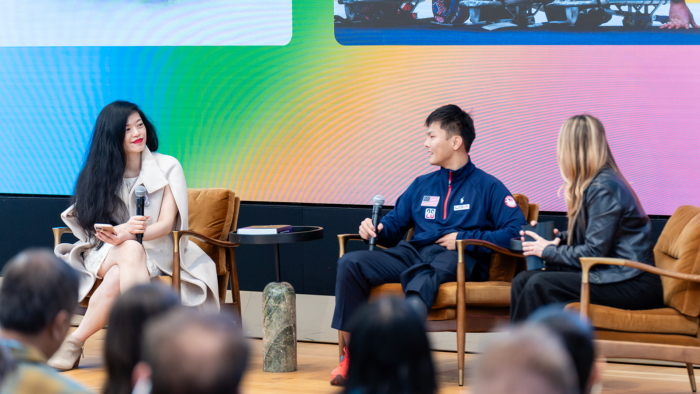
Paralympic gold medalist Brett Bolton and Yale physician-scientist Jennifer Kwan are bringing Asian American and Pacific Islander (AAPI) perspectives to a growing conversation about how AI can reshape athletic performance, personalized health, and biomedical research.
Elite sports have long been measured against established benchmarks: calories burned, miles logged, recovery times, and performance metrics. But what happens when those standards fail to account for the person behind the numbers? At OpenAI Forum’s Game Changers Summit in San Francisco on October 13th, Character attended the panel to hear from two AAPI voices approaching that question from different vantage points: Paralympic sled hockey gold medalist Brett Bolton and Yale School of Medicine physician-scientist Dr. Jennifer Kwan.
Their experiences reveal a larger shift in how AI could change our understanding of the human body. For Bolton, the challenge is personal: finding training and nutrition guidance that reflects his individual needs as an athlete born without his left leg. For Kwan, it’s scientific: understanding how differences in biology influence health, and how AI tools can help researchers uncover insights that conventional approaches might miss. Together, their perspectives illuminate a future in which athletic performance and health are understood, not through a single standard, but through the complexities of each individual.
For Bolton, that future begins with the everyday calculations behind elite performance. Training recommendations often assume a particular body type, leaving athletes whose physical needs fall outside those assumptions left to adapt the guidance themselves. He described using ChatGPT to account for his missing leg when estimating his calorie needs and energy expenditure, giving him a more relevant starting point for understanding his body and fueling his training.
Even familiar cardio routines required a different approach. Treadmills and stair climbers are staples in most cardio routines, but for Bolton they were out of the picture. By using ChatGPT to explore alternatives, Bolton could bring new alternatives to his personal trainer, who could assess his form, observe how his body responded, and help determine which movements belonged in his routine.
Nutrition became another opportunity to make the numbers more personal. Bolton photographed his meals and used ChatGPT to estimate calories and macronutrients, creating an additional reference point for tracking his progress. These features point to a broader possibility: AI can help athletes ask more individualized questions about their bodies rather than simply measuring themselves against established expectations.
That distinction matters. AI can generate suggestions, but it cannot independently determine whether an exercise is safe, whether a training adjustment is appropriate, or how an athlete responds physically in real time. Bolton was clear that technology is not a substitute for the people who know his body and training firsthand.
“You’re not going to just completely take AI and be like, ‘Hey, this is exactly how I’m going to train,’” Bolton said.
Instead, AI gives him another way to explore options and arrive at more informed conversations with his trainer. The technology offers possibilities, while human expertise helps determine which ones are worth pursuing. His experience illustrates how personalization can begin not with a breakthrough discovery, but with a tool that better accounts for the person using it.
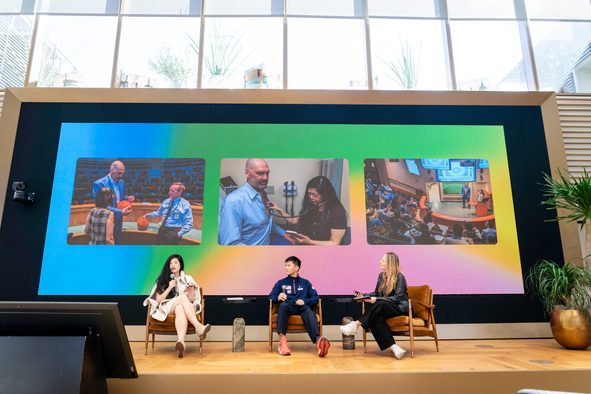
Kwan approaches the same question from the other side of the equation: how can researchers build a more complete picture of the body? As a cardiologist and physician-scientist at Yale School of Medicine, her work examines how biological information can reveal insights that traditional measures of health may overlook. An athlete might demonstrate extraordinary strength and endurance while still carrying underlying health risks that performance alone cannot reveal.
“Athletes are extraordinary on the court, but they can still carry risks that the scoreboard will never reveal,” Kwan said.
She pointed to former NBA champion Scot Pollard, whose heart transplant underscored the fact that elite athletic achievement does not necessarily tell the whole story of a person’s health. For Kwan, caring for athletes means looking beyond what their bodies can accomplish during competition and considering what they may need throughout their lives after their athletic careers end.
Her research draws on multiple layers of biological information, including genetics, proteins, and heart imaging. Each offers a different perspective on the body, while newer techniques can reveal details that broader measurements may miss.
Connecting those layers of information is a complex task, and Kwan described using OpenAI tools alongside other AI tools to support different stages of her research. These applications include reviewing scientific literature, developing analysis code, and exploring relationships among research findings. By helping researchers work across large amounts of information, AI can make it easier to investigate questions such as whether an existing drug might act on a biological pathway associated with a disease.
But a promising connection is not the same as a proven treatment. Researchers must still assess the underlying data, interpret their findings, and determine which hypotheses warrant further investigation. For Kwan, AI’s potential lies in helping scientists pursue more informed questions—not removing the human judgment required to answer them.
That judgment begins with another question: whose biology is represented in the data?
“Asians are significantly underrepresented in genomic studies,” Kwan said.
The gap has implications beyond representation alone. If the biological data used to inform research and train AI models does not adequately reflect the people who will rely on those tools, the resulting insights may be less relevant to their needs. Kwan emphasized the importance of including a wider range of people in genomic research, while also accounting for differences across sports, genders, and body types when developing models for athletes.
Her point brings the conversation about AI back to the individual. Personalization depends on more than a model’s ability to process information; it also depends on the breadth and quality of the information it has learned from. A tool cannot reliably account for differences that its underlying data fails to capture.
For AAPI communities, this raises important questions about who participates in the research shaping future health technologies—and whose experiences inform the systems that may eventually guide care. Kwan’s work highlights the importance of addressing gaps in biomedical research, while Bolton’s experience demonstrates what more individualized guidance can look like in practice. Together, they show how lived experience and scientific expertise can help challenge assumptions built into conventional approaches to health and performance.
Kwan is also exploring the potential for an athlete-specific AI foundation model that could bring together information collected across training, competition, injury, and recovery. Such a model could help researchers investigate questions about when an athlete may need additional rest or whether changes in their health could be identified earlier. Rather than treating performance as a collection of isolated statistics, this approach could help researchers examine how different aspects of an athlete’s life and physiology relate to one another over time.
The possibilities, however, come with significant responsibilities. Developing such a model would require sustained collaboration, secure data resources, and human oversight to determine whether its recommendations actually improve outcomes. It would also require athletes’ informed consent and strong protections for their personal information. Kwan raised concerns about sensitive health or genetic data being used against athletes in contract negotiations or roster decisions, a reminder that information intended to improve care could also create new vulnerabilities if handled irresponsibly.
These questions make the work of people like Bolton and Kwan especially relevant to the evolving conversation around AI. The future of biomedical innovation will depend not only on what technology can uncover, but also on how those discoveries are applied, who benefits from them, and how the people whose data makes them possible are protected.
For Character, their perspectives also underscore the contributions AAPI professionals are making across this landscape. Bolton brings the experience of an elite athlete navigating the limitations of standardized guidance. Kwan brings the scientific expertise to examine how biology, data, and AI might lead to more individualized approaches to health. Their work differs, but both challenge the assumption that one model can adequately account for every body.
At the Game Changers Summit, personalization became tangible in the details: a calorie estimate that accounts for a missing leg, a trainer watching an athlete’s form, a researcher investigating whose biology is missing from a dataset. These moments offer a grounded view of what AI’s potential could mean for the future of sports and medicine, not simply faster calculations or more data, but a more nuanced understanding of the people behind them.
The next era of athletic performance may be shaped by increasingly sophisticated models, but its progress will depend on a fundamental principle: the better we understand individual differences, the better equipped we are to support individual needs. By bringing their experiences and expertise to this conversation, Bolton and Kwan are helping push the field toward a future in which innovation begins with the person, not just the numbers.