
Helen Hong has built a comedy career defined by sharp honesty, emotional range, and an instinct for finding humor in life’s most unexpected and personal places. From early stand-up stages to appearances across television, radio, and voice work, she has carved out a voice that moves easily between irreverence and vulnerability, often within the same breath. Her work reflects a deep commitment to connection, using comedy not just to entertain, but to open up space for shared experience and recognition. This conversation looks at how she turns real-life struggle into material, what she has learned from years on stage, and why laughter, for her, is ultimately about making people feel less alone.


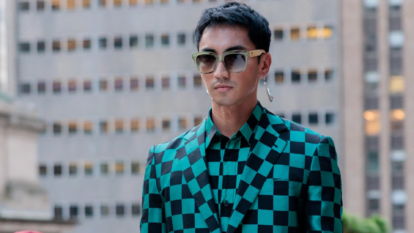
Helen Hong @funnyhelenhong wearing @KaftanStudio dress @Toukitsou hat @SojosVision sunglasses @MartaMijanic gloves @Jonak boots Photographed by Kenneth Medilo @kenmedilophoto
Styling + Creative Direction Benjamin Holtrop @benjaminholtrop at @thewallgroup
Grooming Brittany T, Nikki L, Kelly T, Kahn at @KellyZhangAgency
Production Aleksandar Tomovic @alekandsteph
Socials Tesia Kuh @thefirstthree.co
Production Coordinator Chalisa Phiboolsook @chalisaphi
Talent Coordinator Isabella Nuqui @_snowdust_
Location BELLO Media Group x Maison Privée @BELLOmediaGroup @maisonpriveePR_LA


You’ve built your voice in comedy by being sharp, honest, and very real. What first pushed you to get on stage and speak your truth? I first tried out standup because I was depressed! I was working in a field that was not fulfilling and I was like “is this all there is to life?” I stumbled onto a standup comedy class and the first time I got onstage, BOOM that was it! I knew immediately that it was what I wanted to do for the rest of my life. Those first years all I wanted was to get a laugh. But over the years I realized I could get laughs while also sharing my struggles and making a human connection. I’ve joked about my challenges with mental illness and my experience with breast cancer, and found that I can make people laugh and also touch people who are struggling in their own lives. It’s so fulfilling when people wait to speak to me after my shows and hug me and say “thank you for sharing that!”
Your humor often calls out everyday moments people don’t always talk about. How do you decide what’s worth turning into a joke? Anything that I find funny is worth trying out as a joke! I keep my antennae up constantly for anything that makes me chuckle, from something I see in traffic or an interaction that I overhear on the plane. Or some random silly idea that just pops into my head. I was sitting in a public bathroom stall and saw a sex-traffic hotline notice and thought “I’m in my 40’s, I’m officially too old to get sex-trafficked.” And that was a premise that I developed and teased out and now it’s a bit that’s been doing really well lately. And it all came from letting my mind wander while sitting on the loo. Anything is worth trying out, and the audience will let me know IMMEDIATELY if it’s working or if it’s only funny in my head!
What’s something about your journey in comedy that people wouldn’t expect? My standup is generally not “clean comedy,” considering the F-bomb is practically my favorite word! But I’ve made a career being on NPR (Wait Wait Don’t Tell Me and Go Fact Yourself) and also having a long-running role on a Nickelodeon kids’ series (The Thundermans.) Sometimes people are surprised that the same comedian can be both dirty or squeaky clean depending on the situation. When I started, I NEVER thought my career would include being on a kids show, but I’ve heard that Bob Saget (the dad on Full House) is very dirty on stage and probably thought the same thing!
You’ve been in the industry for a while, have you seen real change in how Asian American comedians are received? Yes absolutely. When I started, the only Asian comic that most people knew of was Margaret Cho. I got compared to Margaret all the time because she was literally the only example. Over the years we’re seeing more and varied Asian voices and perspectives and we’re not a novelty anymore. It’s fantastic that everyone has such a different flavor. Margaret is different from Ali who’s different from Atsuko who’s different from me.
What’s your process like after a set, are you replaying everything or letting it go? Ugh, I suffer from the same mental disease that a lot of people can relate to which is when things go well, I forget it immediately, but when things go wrong I obsess about it for dayyyyyys. There are bad shows from 2 years ago that I’m still thinking about! (face melt emoji)
If you could leave audiences with one feeling after your set, what would it be? I just want people to walk out after my shows in a great mood because they’ve had a great time. I don’t set out to be preachy or polarizing or try to have an agenda other than making people laugh. I do a lot of crowd work but I’m not mean or negative. I’m proud to say that people are just in a great mood when they leave my shows, and even if I’ve done a ton of crowd work, none of it was mean spirited and everyone leaves unscathed!