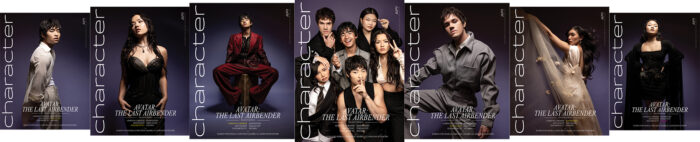


Suit: NAZRANAA @nazranaanj
Talent: Leonardo Nam — @leonardo_nam
Photographer: Kathlyn Almeida — @photosbykathlyn
Stylist: Peiwen Wang — @p3wenwang
Groomer: Carol Park — @1carolpark
PR: Joelle Onukwubiri at ICON PR — @icon_pr
Fashion Director: Benjamin Holtrop — @benjaminholtrop
Video Interview: Alberto Gonzalez — @alberto_filmdirector
Production: @bellomediagroup × @alekandsteph × @maisonpriveepr_la
C: Returning to play Maddox Hatter in Descendants: Wicked Wonderland gave audiences a chance to see a very different side of the character. What excited you most about revisiting him, and how did you approach revealing those new layers without losing what fans already loved about him?
L: What excited me was discovering that the qualities audiences loved in Maddox could also be the source of his unraveling. In Descendants: The Rise of Red, he is warm, eccentric, inventive and deeply devoted to Red. He has this enormous heart. In Descendants: Wicked Wonderland, we see what can happen when that kind of heart is hurt, and the hurt is allowed to harden into anger and obsession.
I never wanted to suddenly announce, “Here comes the villain.” I wanted audiences to keep recognizing the Maddox they knew underneath everything. Even at his most dangerous, I tried to hold on to his love, his playfulness, and his need to matter. In his mind, he isn’t becoming evil. He believes he is correcting something that has gone terribly wrong.
It was also an incredible creative stretch. I was being asked to go further physically and emotionally, and to sing and dance professionally for the first time. There was a moment when I thought, “Am I ready for all of this?” But that became part of the joy. Maddox reminded me that the goal isn’t to stay the same. The goal is to stay curious.


Shirt: MAISON MARGIELA @maisonmargiela, Blazer: WEISHENG @weishengparis, Pants: TAAKK @taakk_official
C: Your career has taken you from independent films to major studio franchises, prestige television like Westworld, and now Disney’s Descendants universe. Looking back, what has remained constant about the way you choose the stories you want to tell?
L: Curiosity has probably been the constant. I’m drawn to characters who make me lean forward and ask, “Who is this person when nobody is watching?” That can happen in an independent film with a tiny crew or in an enormous fantasy world filled with costumes, visual effects and musical numbers.
When I moved to New York at 19, I knew I wanted to act, but the real turning point came when I understood that acting was a craft. There was an actual process through which you could take what a writer had created and help amplify the humanity inside it. I began in theater, and that sense of rigor has stayed with me.
I’ve also never been particularly interested in protecting one fixed version of myself. Roy in The Perfect Score, Brian McBrian in The Sisterhood of the Traveling Pants films, Morimoto in Tokyo Drift, Felix in Westworld and Maddox Hatter may appear completely unrelated, but each one gave me an opportunity to understand a different life and reveal another part of myself.
After more than 25 years, I still want the work to scare me a little. If I already know exactly how to do it, I’m probably not growing.


C: Having been born in Argentina, raised in Australia, and building your career in the United States, you’ve lived between cultures for most of your life. How has that global perspective shaped both your identity and the characters you’re naturally drawn to?
L: I was born in Buenos Aires to Korean parents, raised in Sydney, and then moved to New York before eventually building my life in Los Angeles. More recently, I learned that I also have Japanese ancestry, so even my understanding of my own heritage continues to evolve. For a long time, I thought I needed to find one neat answer to the question, “Where are you from?” Eventually, I understood that the layers are the answer.
Growing up between cultures teaches you to observe. You learn that humor changes from one room to another, that people express affection differently and that belonging can be something you negotiate rather than automatically possess. I think that made me an actor before I knew I was becoming one. I was constantly listening, watching and learning how people communicated.
That perspective is something I bring to every character, but I don’t want audiences to see me and automatically think, “This must be an Asian character whose purpose is to explain his identity.” I think part of our evolution is allowing the character simply to be a character. Like every actor, I arrive with my own history, point of view and texture. My heritage and the places that have shaped me are part of what I contribute, but they don’t have to become the explanation for why the character exists.
Maddox is a wonderful example. His place in the Disney universe is effortless. We don’t stop the story to explain or justify his Asian identity. He gets to be an inventor, a mentor, a father figure and, eventually, a wonderfully complicated villain. He can be eccentric, funny, loving, wounded, dangerous and magical.
That is what I’m always looking to add: greater specificity and texture without reducing the character to an identity lesson. My heritage isn’t a limitation on the stories I can tell. It is one of the many sources of my imagination.


Sweater: TAAKK @taakk_official, Shorts: SAMUEL GARTNER @samuelgaertner, Shirt: ATELIER CILLIAN @ateliercillian, Loafers: COLE HAAN @colehaan
C: Many actors talk about transformation, but you’ve consistently disappeared into characters that are wildly different from one another. Is there a part of your preparation process that audiences would be surprised to learn about?
L: I think people might be surprised by how physical and sensory my process can be. I don’t begin by asking how a character should look. I begin by asking what he carries in his body, how he enters a room, what he notices and what he is trying not to reveal.
For Maddox, clown training was enormously helpful because clowning requires complete commitment, rhythm, and a willingness to look ridiculous. You can’t apologize for the choice.
In The Rise of Red, I imagined Maddox as a blooming rosebush, abundant, open and full of life. Each rose represented another expression of his enormous heart. His energy reached outward toward Red and the people around him. There was generosity, softness and a slightly unruly quality to the way he moved.
For Wicked Wonderland, that central physical image became a tidal wave. All of the love and emotional force that had once blossomed outward had become more volatile and overwhelming. A tidal wave can be beautiful and powerful, but it can also consume everything
in its path. That helped me understand how Maddox’s wounded heart could transform into obsession without losing the emotional connection between the two versions of him.
The costumes became part of that physical language because they had so much movement of their own. You couldn’t casually wander into a scene dressed like Maddox. Music was another doorway for me. Green Day and Ozzy Osbourne helped unlock his rebellious, unpredictable energy.
I’ll also build private memories for a character that never appear in the script. The audience may never know exactly what those memories are, but hopefully they can feel that there is a whole life underneath the dialogue.


C: You’ve recently launched Good On Ya Productions, expanding your role beyond acting into producing. What kinds of stories do you feel are still missing from today’s entertainment landscape, and why is now the right time for you to help bring them to life?
L: After more than 25 years of helping bring other people’s stories to life, I began asking what else I could contribute. Acting remains my first love. Producing isn’t a departure from that. It is an expansion of the same impulse.
With my production company, Good On Ya Productions, I want to develop emotionally grounded, commercially exciting stories that can travel across cultures. My life has been connected through Argentina, Korea, Japan, Australia, and the United States, so I’m especially interested in building creative bridges among those worlds.
What I believe is still missing is not simply representation in front of the camera. We need a greater range of people participating in authorship, ownership and decision-making. I want Asian and other historically underrepresented characters to be allowed the full messiness of being human. They shouldn’t always have to be exemplary or explain an entire culture. They can be flawed, ambitious, hilarious, romantic, contradictory and completely specific.


Total Look: TAAKK @taakk_official
I finally have enough experience to know both what I know and what I don’t know. I have relationships, perspective, and a clearer sense of purpose. Earlier in my career, I was focused on getting into the room. Now I’m asking what rooms we can build and who else we can invite in.
C: The entertainment industry has changed dramatically since you first arrived in Hollywood. In what ways do you think opportunities for Asian actors have genuinely evolved, and where do you still hope to see meaningful progress?
L: The evolution is real. When I began, the mere presence of an Asian actor in a substantial role could feel exceptional. We were often discussed as evidence of progress rather than simply as artists doing interesting work. Today, audiences are embracing Asian and Asian diaspora performers across genres and languages, and there are far more actors whose careers don’t have to follow one predetermined path.
A significant part of that evolution for me can be seen through Brian McBrian in The Sisterhood of the Traveling Pants films. In the first film, Brian was sweet, emotionally open, and romantic. Then, in The Sisterhood of the Traveling Pants 2, the character was allowed to become sexual
as his relationship with Tibby developed. Particularly in a major studio film at that time, being seen as an Asian man who could be desirable, romantic, and sexual felt genuinely significant. His ethnicity wasn’t the subject of the relationship, and his desirability wasn’t treated as unusual or something the movie needed to explain. He was simply allowed to be part of the full romantic and sexual life of the story.

Total Look: OCCHII @occhiinyc
That is also one of the reasons I took Love Is the Monster. I had never seen a man who looked like me leading a genre-horror film as such a deeply sexual character. It felt strange, daring and a little frightening to me, which was exactly why I wanted to do it. I wanted the opportunity to explore desire, intimacy, danger, and vulnerability from a much more adult and complicated perspective. Asian men are still too rarely given that kind of sexual agency on screen, particularly as the lead of a genre film.
Those two experiences happened at very different points in my life and career, but they are connected. Both allowed me to play a person whose Asian identity informed the texture I brought to the role without limiting the character’s emotional, romantic or sexual possibilities.
That is where I still want to see progress. Visibility is not the finish line. We need more Asian writers, directors, producers, executives and financiers with the authority to decide which stories are made. We also need Asian actors to have access to the entire human spectrum. We should be able to lead romances, horror films, fantasies, comedies and science-fiction stories without our identities always being treated as the central issue the story must explain.
We also need room for failure. Real equality means one Asian-led project doesn’t have to carry the future of every Asian-led project. We should be able to succeed, fail, experiment, take risks and simply keep creating, just like everyone else.
I want us to move from being grateful for inclusion, to participating fully in authorship and ownership — while also preserving the sense of community that helped so many of us through the earlier years.


C: Whether you’re working on a fantasy adventure, science fiction, or an intimate drama, your performances always feel deeply human. How do you find emotional truth even when the world surrounding your character is completely extraordinary?
L: The world may be extraordinary, but the need is usually very ordinary. A character in Westworld still needs dignity, connection, or freedom like any other human being. A magical inventor in Wonderland — as fantastical as it is — still needs love, forgiveness, or a sense that his life matters.
I try to strip away the scale of the production and ask very simple questions: Who do I love? What am I afraid of losing? What do I need from the person standing in front of me? What am I unable to say?
That was essential with Maddox. You can play the hat, the hair, the magic, and the theatricality as wonderfully fun. But none of that matters unless there is a person underneath. His obsession had to grow from something recognizable — a wounded heart and an inability to release the pain.
Genre actually gives us a beautiful way to explore human emotions. It can make an internal experience visible. Grief can alter time. Fear can become a monster. Anger can tear apart a
kingdom. My job is to believe in the emotional event with the same conviction that the world believes in the magic.
C: Fatherhood has become an important part of your life alongside an incredibly busy career. Has becoming a parent changed the kinds of projects you want to pursue or the perspective you bring to your work as an artist?
L: Completely. My husband and I have twin nine-year-old boys, and fatherhood has changed both my relationship with time and my definition of success.
There is something extraordinary about being part of a Disney universe that my children can enter with me. Watching them experience the premiere in Los Angeles and seeing Maddox through their eyes gave the work an entirely different meaning. They were excited, but they were also very quick to give me notes — which keeps an actor humble!
More deeply, becoming a father made me think about what I am building rather than only what I am booking. I still care enormously about the next role, but I also think about the stories my sons will inherit, the images that will help shape their understanding of family as well as masculinity, and whether the work contributes something lasting.
They have also made me more emotionally available as an actor. Children live very close to wonder, fear, embarrassment, and joy. Nothing is abstract to them. Being around that honesty reminds me not to protect myself too much in the work.
I want my sons to see that a creative life can keep evolving and that courage doesn’t mean being unafraid. It means remaining curious enough to try.


Suit: NAZRANAA @nazranaanj
C: You’ve worked with filmmakers across so many genres and generations. Is there a particular collaboration that fundamentally changed the way you think about acting, or even about creativity itself?
L: Working with Ava DuVernay on Origin changed me. The film asked enormous questions about history, hierarchy, and human connection, but Ava created an environment in which those ideas were always rooted in people. She leads with extraordinary clarity, but also with a profound sense of purpose. It reminded me that the way a story is made is part of what the story ultimately communicates.
I’ve been fortunate to work with many directors who expanded a different part of me. Lisa Joy and Jonathan Nolan on Westworld showed me how much emotional intimacy could exist inside an enormous philosophical and technological world. Kimmy Gatewood, on Descendants: Wicked Wonderland, created a sense of play and permission that allowed me to take risks with singing, movement, and comedy while still protecting Maddox’s emotional journey.
The collaborations that stay with me are the ones where rigor and play coexist. Great creative leaders know exactly what story they are telling, but they still leave enough air in the room for discovery.
That is something I’m carrying into Good On Ya. I don’t want to build a company where creativity becomes purely transactional. I want to create environments where people feel safe enough to be brave.

C: When audiences look back on your body of work years from now, what do you hope connects all of those performances? What do you want people to understand about Leonardo Nam, not just as an actor, but as a storyteller?
L: I hope they see curiosity. I hope they see someone who kept reaching toward people and experiences that were different from his own, and who tried to find the humanity inside every world he entered.
I don’t need all the characters to form one neat picture. In fact, I hope the body of work remains surprising. I would love for someone to discover that Roy from The Perfect Score, Brian McBrian from The Sisterhood of the Traveling Pants films, Morimoto from Tokyo Drift, Felix fromWestworld, David in Love Is the Monster and Maddox Hatter were all played by the same person and think, “Oh, he really wanted to explore.”
Beyond acting, I hope people understand that storytelling, for me, has always been connected to belonging. I grew up between countries and cultures, built a life with my husband, became a father, and spent more than 25 years navigating an industry that was itself changing. All of that has deepened my belief that stories can help people recognize themselves and become curious about one another.
This chapter with Good On Ya Productions is not about leaving acting behind. It is about taking everything that acting has taught me and using it to help build worlds, create opportunities, and support other voices. The goal isn’t to stay the same. The goal is to stay curious.


Total Look: TAAKK @taakk_official