Courtesy of NEON / PLUS M Entertainment
What if the scariest thing about a monster movie isn’t the monster?
Na Hong-jin’s Hope arrives with all the ingredients of a cinematic nightmare: a remote South Korean town, mysterious deaths, a creature capable of throwing cars through the air, and a police chief who has absolutely no idea what he is dealing with. On paper, it sounds like the kind of movie designed to make you sleep with the lights on.
But Hope is ultimately less interested in frightening you than in asking a much stranger question: what happens when we don’t know who or what the enemy is?
And that is where the film becomes genuinely intriguing.
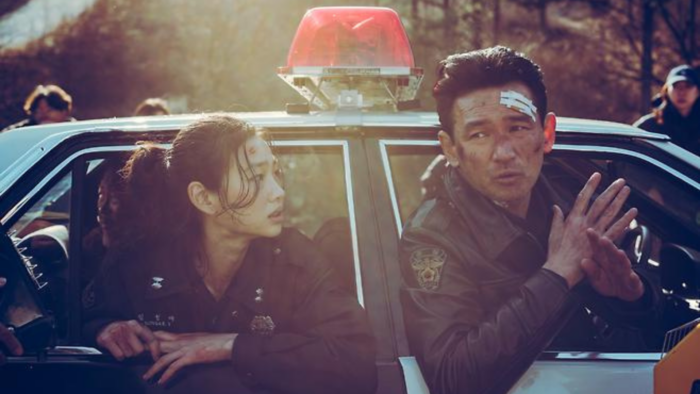
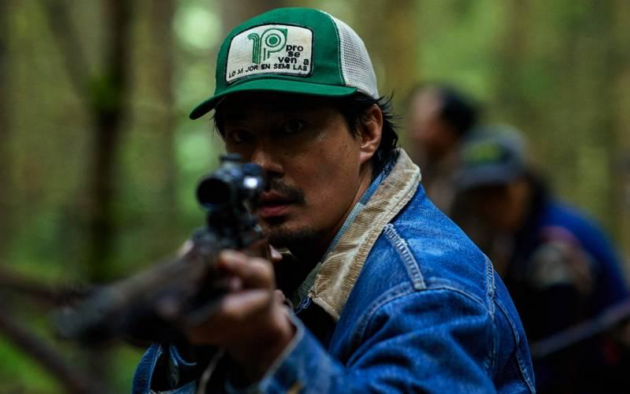
Na, best known for The Chaser, The Yellow Sea, and the cult favorite The Wailing, returns to the frantic, violent energy of his earlier films. The story begins when Bum-seok, a local police chief played by Hwang Jung-min, is called to investigate the strange death of an animal. He assumes the culprit is a tiger. Then he returns to town and discovers that almost everyone is dead.
From there, Hope becomes a survival nightmare.
And for a while, it is fantastic.
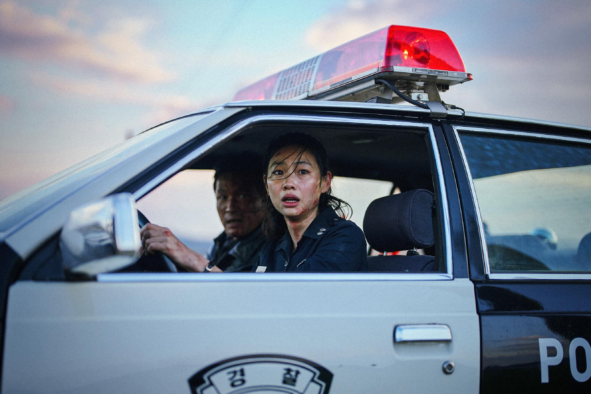
Na knows how to create panic. He lets us hear the creatures before we see them. A pair of hands disappears into darkness. Someone runs down a street while something enormous follows behind them. The camera suddenly flies toward a car and then launches away as the vehicle speeds off. The action feels chaotic without being completely incomprehensible—a difficult balance that Na has mastered before.
Then the monster finally appears.
And somehow, that is when some of the magic disappears.
The creatures can look strangely digital, occasionally resembling something from an early-2010s video game rather than a terrifying new species. One creature, with its elongated body and exposed anatomy, seems almost suspiciously familiar to anyone who has spent time with Resident Evil. In a film surrounded by impressive practical effects, the digital creatures sometimes feel like they wandered in from another movie.
Which is unfortunate, because Hope understands something very important about horror:
The things we imagine are often scarier than the things we can see.
But the creatures are not really the most interesting part of the film anyway.
The real monster might be the idea of “the other.”
Hope takes place near the Korean Demilitarized Zone, a location that carries enormous historical and political weight. Throughout the film, there are reminders of borders, infiltration, weapons, and the constant preparation for an enemy.
The creatures simply give those fears a new shape.
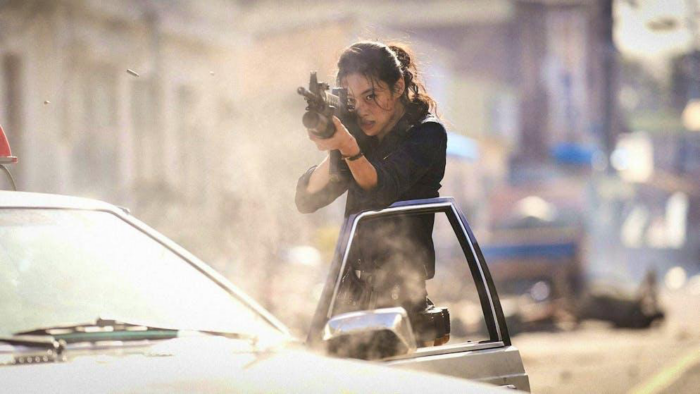
Suddenly, the movie is no longer just about humans versus monsters. It becomes a story about what happens when people encounter something they cannot categorize. Their instinct is immediate: identify it, arm themselves, hunt it, destroy it.
There is something particularly Korean about that anxiety, but it also feels remarkably universal.
We live in an era obsessed with defining threats. Who belongs? Who doesn’t? Who is invading? Who is dangerous? Who should we be afraid of?
Hope doesn’t exactly reinvent those questions, but it places them inside an enormous, bloody monster movie—and occasionally, that combination works beautifully.
It also helps that the film has a wonderfully strange sense of humor.
Characters argue over who should enter a dark room first. Weapons become increasingly ridiculous. An old man delivers an unexpectedly disgusting story in the middle of all the chaos. And almost everyone seems to know one Korean word particularly well: ssibal.
It is funny, until it isn’t.
That tonal whiplash is part of what makes Na’s movies so distinctive. Horror can suddenly become comedy, comedy can become violence, and violence can become something almost absurd.
Unfortunately, Hope sometimes mistakes chaos for depth.
At roughly two and a half hours, the film has an enormous amount of story to juggle. Characters disappear and return. Plotlines are introduced just as they begin to become interesting. And then, just when the movie seems ready to reveal what all of this means, it opens another door.
And another.
And another.
By the end, there are mysterious names, constructed languages, a giant ship, an enormous crash, new mythology, and enough unanswered questions to suggest that Hope may be less interested in telling one complete story than in building the first chapter of a much larger universe.
That is perhaps its biggest weakness.
In the age of cinematic universes, audiences have become accustomed to endings that are really advertisements for the next installment. But there is something satisfying about a movie that knows how to end.
Hope doesn’t quite have that confidence.
It feels like a beginning pretending to be a conclusion.
And yet, walking away from it, the frustration is almost a compliment.
Because there is clearly something here.
When Hope is cooking, it is really cooking. The action is wild. The practical effects are gloriously disgusting. The cinematography has a physical energy that makes the film feel genuinely dangerous. And beneath all the chaos is an idea about fear, borders, violence, and the human tendency to turn the unknown into an enemy.
The film just doesn’t know how to stop.
Maybe that is fitting.
Because perhaps the most frightening thing about Hope isn’t the creature hiding in the forest.
It is the realization that, after two and a half hours, we still don’t know what the monster really is.
And maybe that is exactly the point.