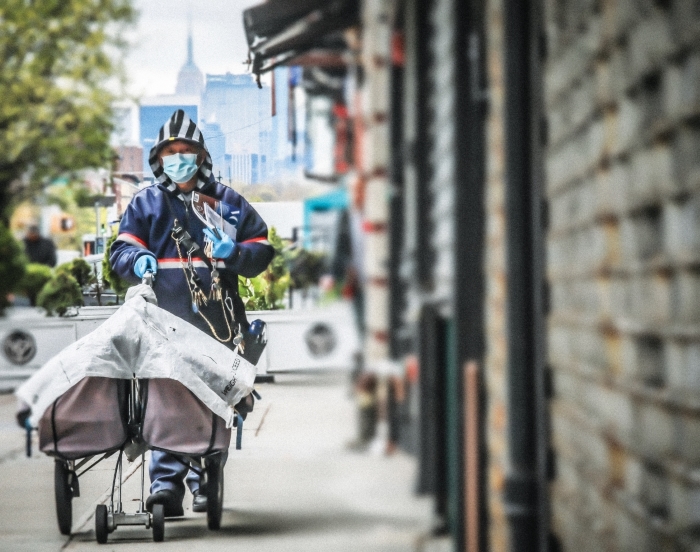
Unlike medical professionals, most journalists are not trained to work during a contagious virus outbreak, let alone a virus with so many unknowns. But as essential businesses, news outlets continue to operate during the COVID-19 pandemic. Reporters are putting themselves at risk in order to get important, indispensable information out to the public while still trying to soothe people’s anxieties during unparalleled times.
“It’s a parenting story; it’s an education story; it’s a personal investment story. It crosses all subjects and boundaries. And so that’s what’s been so fascinating about covering this,” says “Los Angeles Times” staff writer Anh Do, who writes about Asian American issues. Since the onset of the pandemic, she’s been working from home as much as possible, focusing on how COVID-19 is impacting everything from mental health to business. “You can find a story in every corner of life. This is an extraordinary time in journalism when more people are tuning in to the news on all different platforms, and we realize that we have a rare opportunity to do service journalism at its very core, so we try to take that responsibility very deeply.”
As a general assignment reporter with NBCLA, broadcast journalist Gene Kang has less flexibility than some of his peers at the “L.A. Times.” With the onset of shelter-in-place orders across California, Kang has been trying his best to follow social distancing measures while out in the field. But it’s become problematic to do one of the most important parts of a reporter’s job: talking to people. Trying to create a connection with others when there’s six feet between, and a mask covering half your face, is not so easy. “Talking to someone with something on your face is not normal at all. Our job as a reporter is to make people feel comfortable and almost like they’re your friends, in a sense,” Kang says.
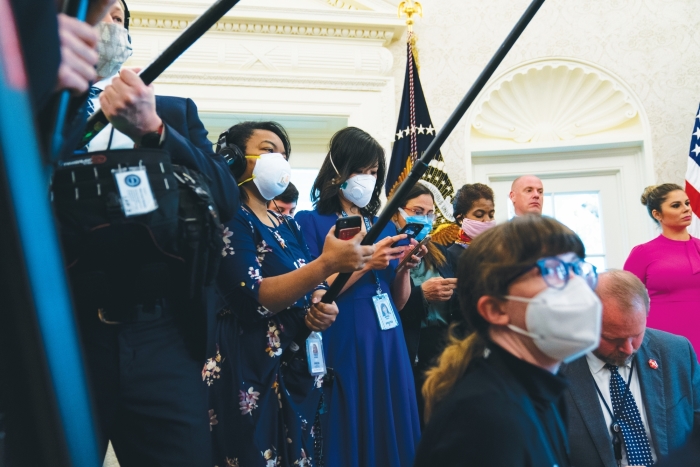
To follow pandemic guidelines, many newsrooms are adapting their reporting and information-gathering practices. In addition to field reporters wearing masks and keeping their distance from people while doing street interviews, microphones are placed on extenders. News anchors do live broadcasts from their homes.
On the other hand, photojournalists like Marcus Yam have chosen to take calculated risks in order to fulfill what they believe are their duties as reporters. Yam is an “L.A. Times” photographer who covered the outbreak in Hong Kong. “Social distance and photojournalism are just like the opposite sides,” Yam says. “It’s selfish to say, but the job is more important right now. Your responsibility to inform the public is more important than any of that. You do have to take caution to not endanger other people, but ultimately, you need to put aside all your personal baggage and really just remember you have one job. You are here to inform the public.”
Reporters are dealing with these difficult tasks while also battling a suspicious public and a hostile government. Distrustful citizens are emboldened by a president who openly attacks the news media on practically a daily basis. In addition to distrust, Asian American reporters must also contend with racial aggressions related to coronavirus fears and some who insist on calling COVID-19 the “Chinese virus.” In March, CNN correspondent Kyung Lah recounted on-air how she was called a racial slur while she was preparing for a segment.
In Kang’s case, he has been lucky to not experience aggression while in the field. As a civilian, however, he says he has noticed suspicious stares at the grocery store and people trying to pick fights with him. He attributes the difference in attitude to the authority a news van and the NBCLA channel 4 microphone affords him. “It’s a double-edged sword because people, they despise the media or they are totally cool with us. It’s been one or the other. It’s almost like there’s no middle ground. And unfortunately that’s also created from our administration right now, which does not like the free press and won’t even answer questions when reporters are asking about things,” Kang says.
Both Do and Kang are members of the Asian American Journalists Association (AAJA), Los Angeles chapter. Do commends the national organization for its release of guidelines on how to ensure fair portrayal of Asian people in news about the novel coronavirus. She says she was not happy with the high number of coronavirus stories published alongside images of unrelated Chinatowns or Asian people.
“They insert a color photo of an ornate gate leading into a specific Chinatown, like in London or Boston, when the story may not even mention those two cities. Language is also extremely powerful, and using terms like ‘Wuhan virus,’ ‘China virus’ or ‘Chinese coronavirus,’ that’s stereotyping to the max,” Do says. “I want to be very clear in our coverage that Asian people are not a disease, and they don’t bring any type of disease. I’ve had a lot of readers write to me to share about different experiences that they’ve witnessed, or have been targeted [by].”
Do herself felt she was targeted at the Guatemala City airport, when she was the last to board a flight to Los Angeles and forced to answer a list of questions about recent travels to China. She was the only Asian person on the flight.
Amidst all the uncertainty and chaos, the journalists are trying their best to ease people’s fears and to bring humanity and kindness to their reporting. “What are people doing in the community to help each other? That’s what people are going to remember when we get through this and we finally get to the end of it,” Kang says. “It’s not going to be the death and destruction story. I never signed up to be a journalist to scare people. That was never my intention. Even when I’m talking to people with a mask on, I try to smile through my eyes. I just want to make people feel comfortable.”
Do, on the other hand, finds inspiration through the stories and people she reports on. “I just find it amazing how extraordinary it is that everyone is working together at very visible levels in all of our communities,” she says. “People who are furloughed or stranded or lost their jobs, they’re volunteering to make face masks or to deliver meals to seniors, or to buy groceries and bring them to the housebound, take in foster dogs for months and hopefully adopt them. It’s really inspiring, and it shows the beauty of community life and how we’re all interconnected.”
This article appeared in “Character Media”’s April/May 2020 issue. Check out our current e-magazine here.